Progressive Formation of Drumlins within the Múlajökull Active Drumlin Field, Iceland
Progressive Formation of Drumlins within the Múlajökull Active Drumlin Field, Iceland
Previously Published Material: Presented as poster on AGU Fall Meeting 2014.Manuscript submitted to JGR 2 January 2015, currently (14 Jan) under review.
Abstract ID#: 34786
English Abstract:
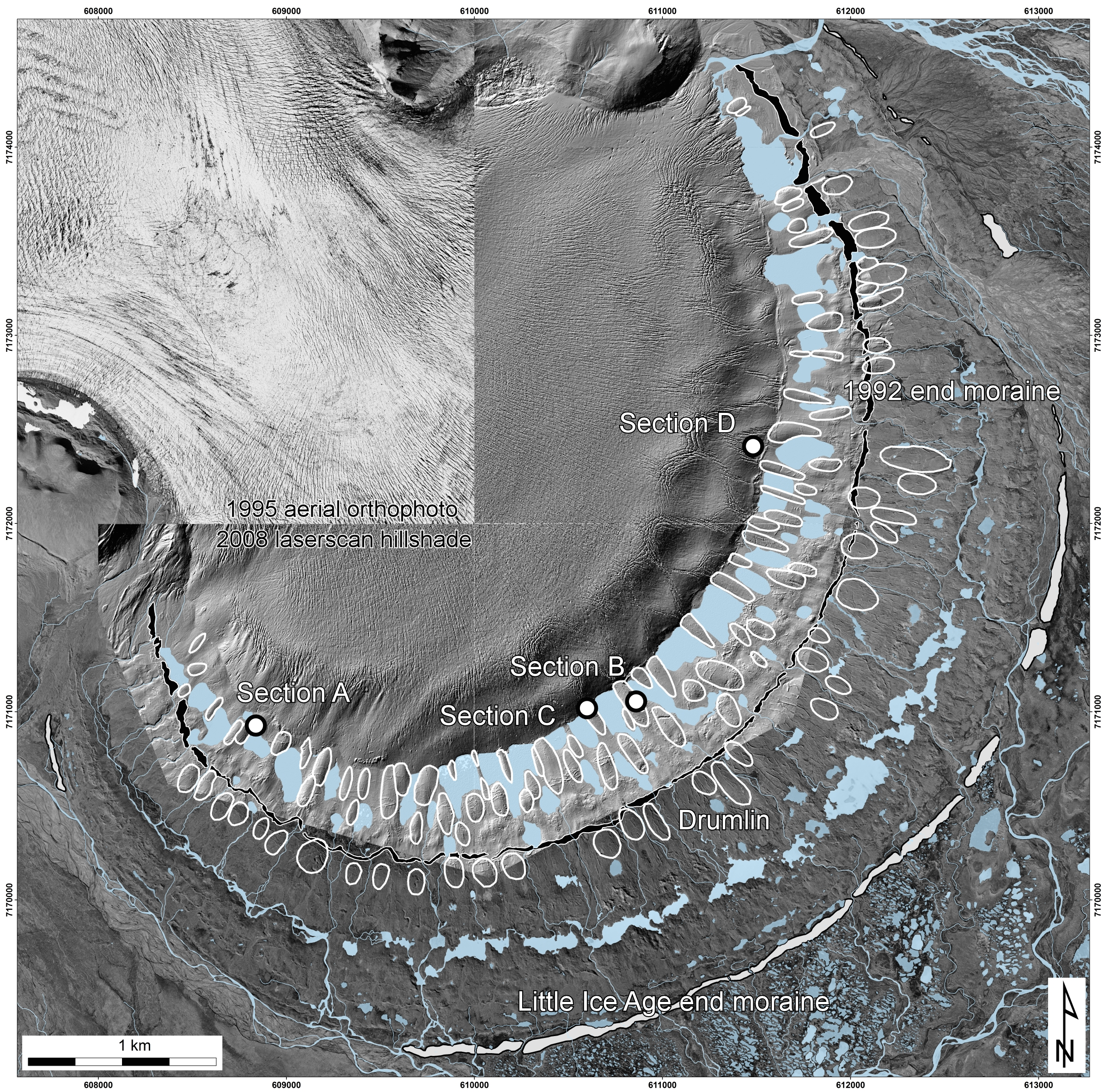
In order to shed light on drumlin formation, the stratigraphy and morphology of drumlins within the active drumlin field at the Múlajökull surge-type glacier in Iceland were studied. A total of 110 drumlins were mapped and measured, and their internal stratigraphy described in four exposures (Fig. 1). All exposures reveal several till units where the youngest till commonly truncates older tills on the flanks and the proximal side of the drumlins. Drumlins proximal to the 1992 surge moraine are relatively long and narrow whilst drumlins distal to the moraine are wider and slightly shorter. A conceptual model is proposed to explain the formation of the drumlins at Múlajökull. Radial crevasses formed in the glacier when it initially spilled onto the flat foreland. These crevasses led to spatial differences in normal pressure at the base of the glacier so that deposition was favoured beneath the crevasses and erosion between them. Consequently, the original crevasse pattern of the glacier controlled the location of proto-drumlins. Once the proto-drumlins were formed, a feedback mechanism was established leading to continued crevassing and increased sedimentation at the location of the proto-drumlins. The drumlins are then maintained and their relief and elongation ratio increases as the glacier erodes the sides and drapes a new till layer over the landform. Our observations of this only known active drumlin field may have implications for drumlins within well-known Pleistocene drumlin fields, and our model may be tested on modern drumlins and drumlin fields that possibly become exposed upon future ice retreat.