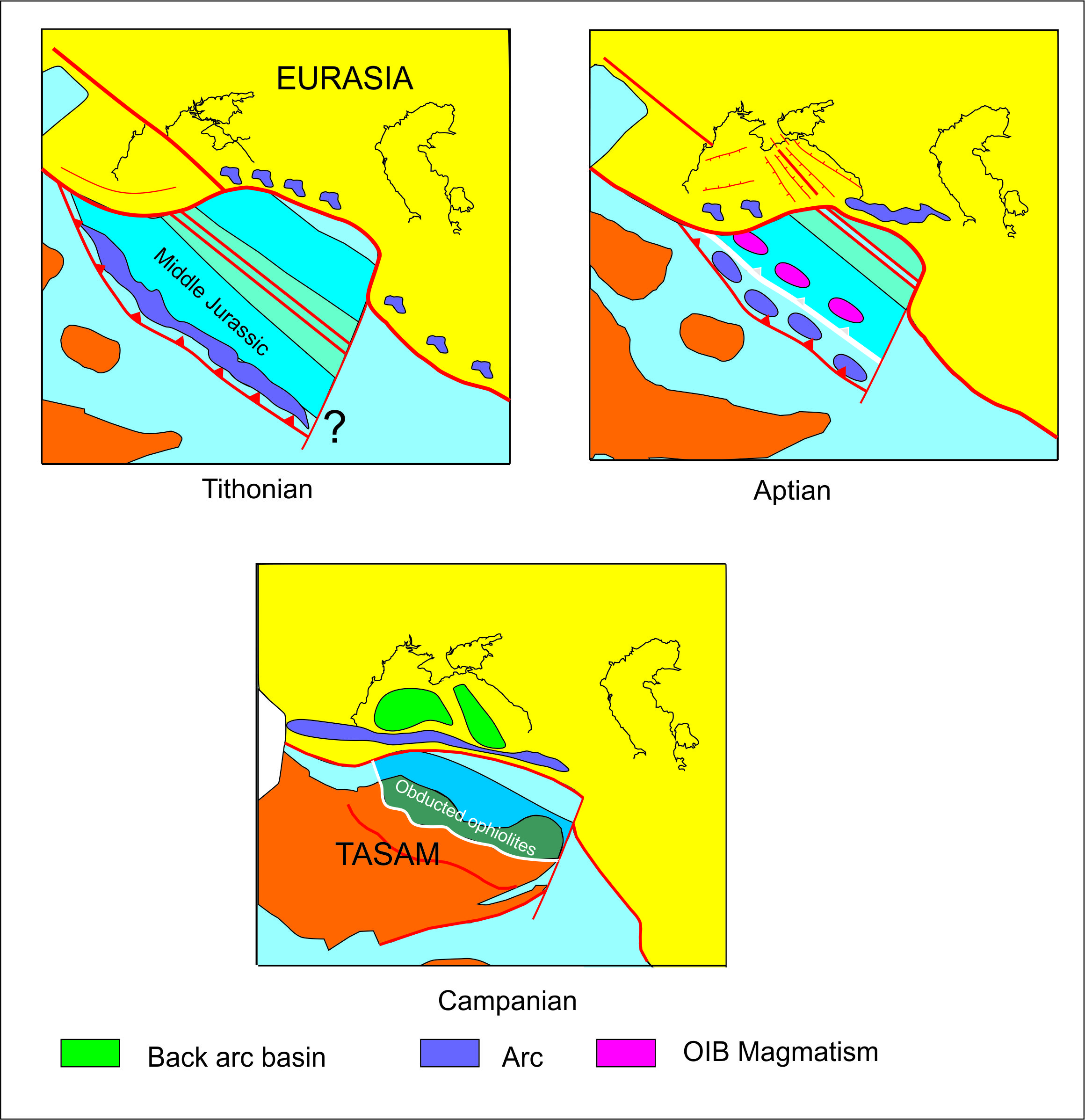
Darius working group of the Black Sea and Caucasus region (http://istep.dgs.jussieu.fr/darius/index.html) has collected new data of stratigraphy, structures, tectonics, palaeomagnetism, petrology, geochemistry, and geochronology as well as the analysis of some seismic profiles.The widespread zone (from the Eastern Black Sea to the East of the Lesser Caucasus and from Greater Caucasus to the south of Anatolia) appears to be a large puzzle of heterogeneous lithospheres (continental, oceanic, arc, fore and back-arc basins) since the Early Cretaceous.
The results obtained during the last decades in the studying of ophiolitic units along the Izmir-Ankara-Erzincan-Sevan-Akera (IAESA) suture zone allow to describe this oceanic domain (southward bordered by an intra-oceanic subduction zone) as a back-arc basin built up within the time frame between Early to Late Jurassic (e.g. Robertson et al., 2014; Hässig et al., 2014). The locations of these ophiolites units defined a wide nappe (at least 200 km wide) with the same range of age (Jurassic). This can be explained as follows: the spreading center axis of the back-arc basin was parallel to the intra-oceanic subduction zone which is now more or less defined along the IAESA suture zone as the obduction front (Hässig et al., 2014; Robertson et al., 2014).
On the other hand, the Black Sea is classically described as a back-arc basin characterized by an active rifting during the Early Cretaceous (see Stephenson and Schellart, 2010; Nikishin et al., 2013, for a review) due to a slab roll-back (as demonstrated by the regional framework of its main extensional structures) of the East-West trending subduction zone. Nevertheless, this E-W trend of the subduction front shown on the paleotectonic reconstruction maps (http://istep.dgs.jussieu.fr/darius/maps.html) is quite incompatible with the N-S, NNW-SSE trends of the Lower Cretaceous rifting axis recently evidenced by field observations in the Crimea Mountains and the NW-SE trend of normal faults limiting Jurassic platform of the Shatsky ridge.
We suggest that the rifting of the Black Sea could be the result of the subduction of the spreading center axis of the IAESA back-arc basin acting as a slab window.