
Does Regional Pressure and Coastal Winds Impact Sea Ice Variability in Antarctica?
Does Regional Pressure and Coastal Winds Impact Sea Ice Variability in Antarctica?
Previously Published Material: The results were accepted to SCAR 2014 meeting in NZ but couldnt be presented due to unavailabilty of funds. This work is under-review for publication in Climate Dynamics Ref no- CLDY-D-14-00176
Abstract ID#: 36327
English Abstract:
As a responsive pointer of global climate change, trends in the sea ice variability in
different Antarctic sectors are thought to be related to the changes in the major climatic
modes such as El Niño/ Southern Ocean and Southern Annular Mode (SAM). But this
study investigates the lesser known impact of regional factors on the interannual and
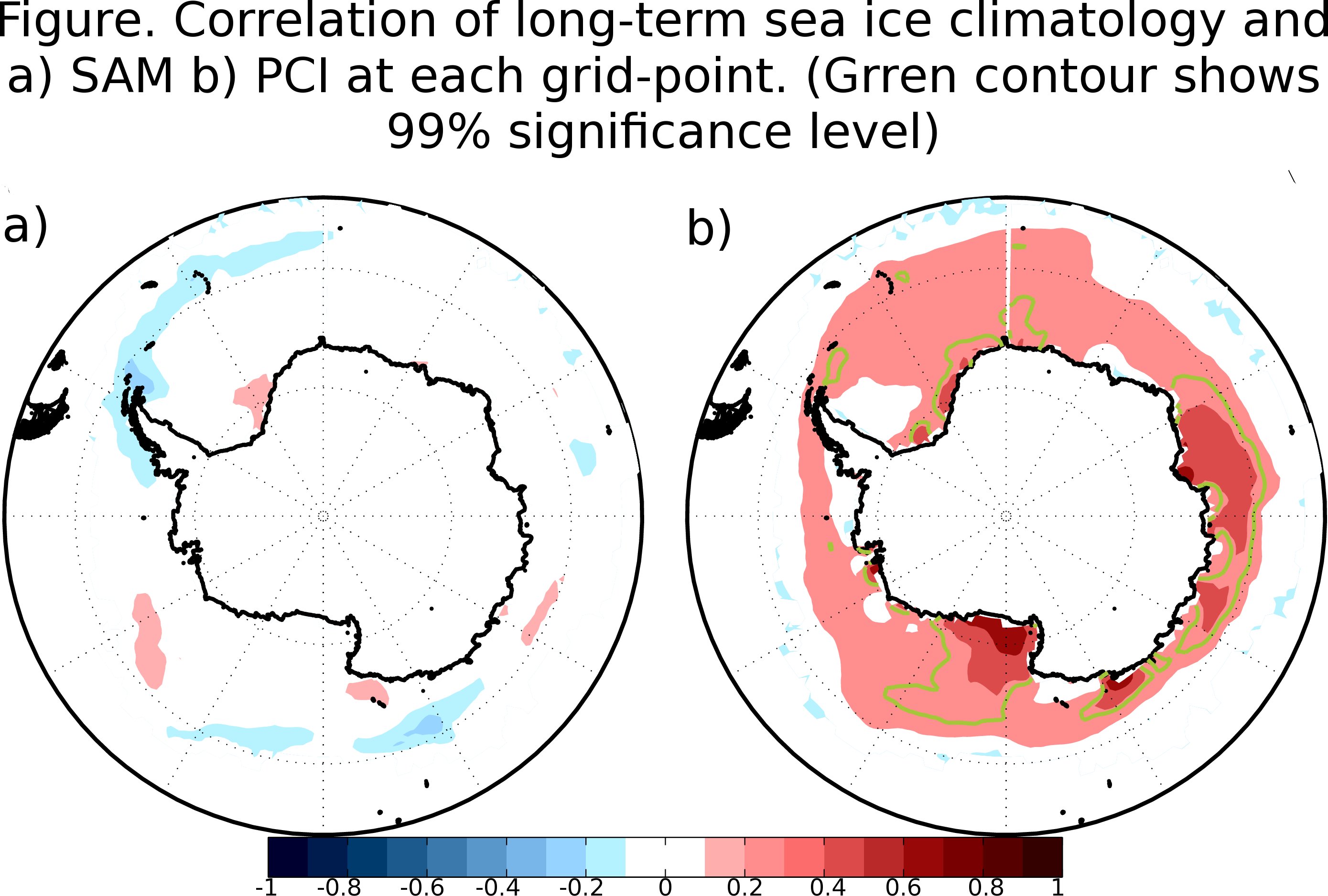
seasonal Antarctic sea ice variability by defining a new Polar Coastal Index (PCI),
which is normalized pressure difference between 90°S and 65°S, and discusses the
role of regional pressure gradients and coastal winds during 1979-2012. The coupling
between PCI and v-component of coastal wind is strong for the East Antarctica which
decreases along the West Antarctica. The PCI is positively correlated with the westerly
zonal and southerly meridional winds in the coastal Ross Sea and along most of the
East Antarctica. Importantly, PCI plays a significant role in the nascent ice formation
stages during late summer/ early autumn. Similarly, the coastal meridional (zonal)
winds in autumn display a strong correlation with the sea ice in East Antarctica (Ross
Sea). Climatologically, the southerly meridional and westerly zonal winds are stronger
in the Ross Sea, hence we find a robust correlation with sea ice, suggesting that the
westerly zonal wind induce Ekman dynamics which play a dominant role there and the
southerly meridional winds are effective in exporting the sea ice northward. In general,
the East Antarctica responds favourably to regional forcing (PCI and coastal winds)
than the West. This study highlights that PCI essentially represents a regional pressure
gradient, hence it can be used to understand the sea ice variability in a different
prospective.
different Antarctic sectors are thought to be related to the changes in the major climatic
modes such as El Niño/ Southern Ocean and Southern Annular Mode (SAM). But this
study investigates the lesser known impact of regional factors on the interannual and
seasonal Antarctic sea ice variability by defining a new Polar Coastal Index (PCI),
which is normalized pressure difference between 90°S and 65°S, and discusses the
role of regional pressure gradients and coastal winds during 1979-2012. The coupling
between PCI and v-component of coastal wind is strong for the East Antarctica which
decreases along the West Antarctica. The PCI is positively correlated with the westerly
zonal and southerly meridional winds in the coastal Ross Sea and along most of the
East Antarctica. Importantly, PCI plays a significant role in the nascent ice formation
stages during late summer/ early autumn. Similarly, the coastal meridional (zonal)
winds in autumn display a strong correlation with the sea ice in East Antarctica (Ross
Sea). Climatologically, the southerly meridional and westerly zonal winds are stronger
in the Ross Sea, hence we find a robust correlation with sea ice, suggesting that the
westerly zonal wind induce Ekman dynamics which play a dominant role there and the
southerly meridional winds are effective in exporting the sea ice northward. In general,
the East Antarctica responds favourably to regional forcing (PCI and coastal winds)
than the West. This study highlights that PCI essentially represents a regional pressure
gradient, hence it can be used to understand the sea ice variability in a different
prospective.