Characterization of the Stress-strain Relationship of the Precambrian Basement Rocks of the Stable Platform in the Northwest Bangladesh
Characterization of the Stress-strain Relationship of the Precambrian Basement Rocks of the Stable Platform in the Northwest Bangladesh
Abstract ID#: 36598
English Abstract:
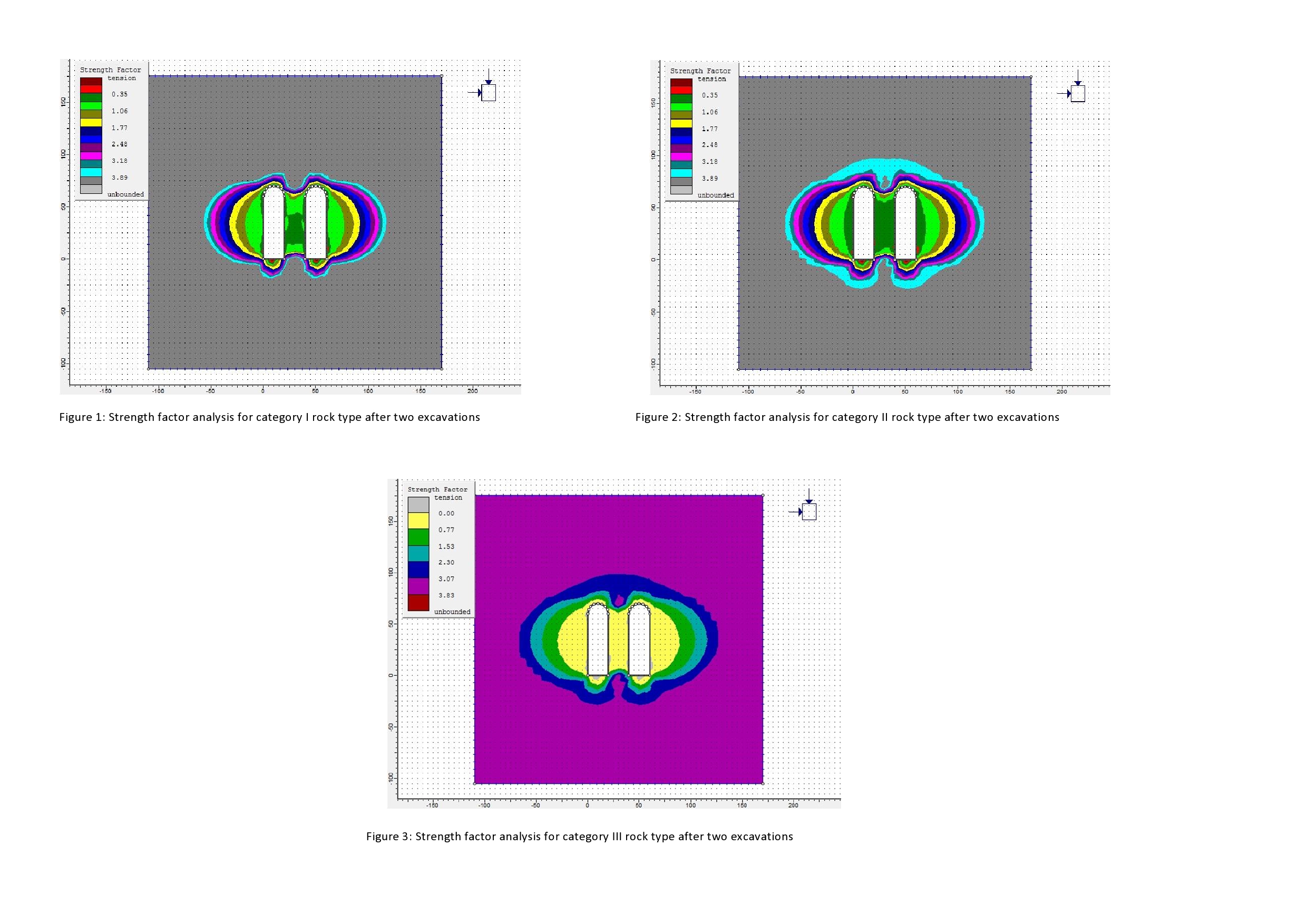
Recently Bangladesh has undertaken its second underground mining and first Hard rock mining project at Maddhapara where Precambrian basement rocks, consisting igneous and metamorphic rocks of mainly Granodioritic composition, occur at a depth of 128m (borehole GDH-24) to 326m (borehole GDH-26). A major aquifer bearing formation, Dupi Tila, overlies the fractured crystalline basement formation. Even a slight subsidence or any fault displacement affecting both the aquifer and highly fractured and fissured basement formation may inundate the entire mine area. Hence stress analysis in and around the excavation area is an essential task for mine design. We investigated the stress-strain relationship of the rocks of three different categories of Maddhapara Granite Mine. The samples of rock category I, II and III were prepared according to ASTM (American Standard for Testing Material) concrete block. The Uniaxial Compressive Strength (UCS) values of tested rock samples of category I, II and III show that the rocks are of brittle nature and they abruptly fail at the stresses of 126.39 MPa, 59.1 MPa and 39.58 MPa respectively. The stress-strain relationship of the tested samples indicates that some of them fail within the elastic range while others fail beyond the elastic range. The average lower tangent modules values of category I, II and III are 17.91 MPa, 13.73 MPa and 8.73 MPa respectively. From the strength factor and failure trajectories analyzed using the Examine2D software, it is evident that category I rock type is the strongest and is unlikely to fail. Category II is weaker than category I rock type and is to fail. Rock type Category III is the weakest and is highly vulnerable. The obtained results will enable us to gain a better understanding of the effectiveness and stability of present support design.