Spatial Correlation Analysis of Niño3.4 SST with Western North America Hydroclimate
Spatial Correlation Analysis of Niño3.4 SST with Western North America Hydroclimate
Abstract:
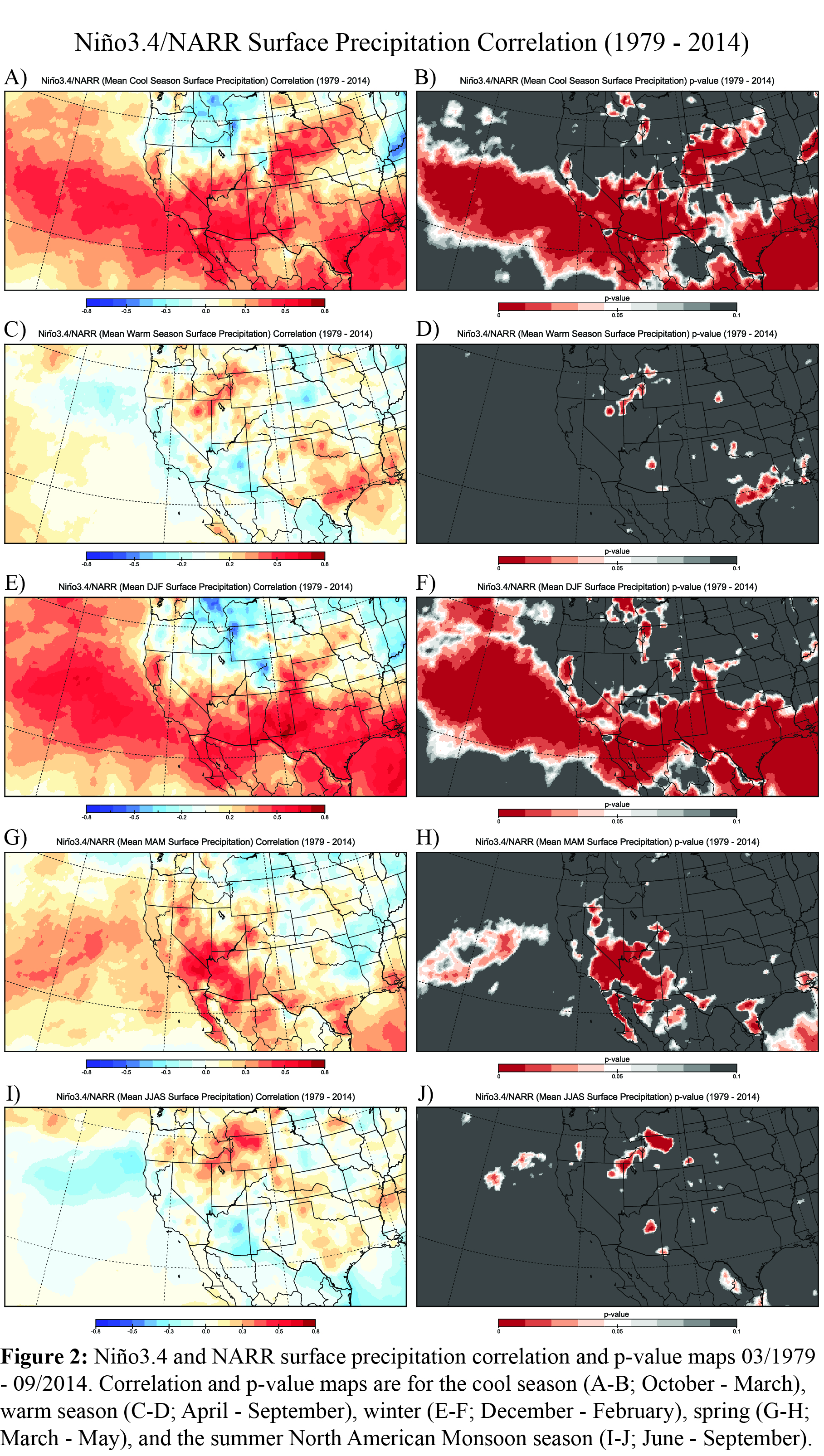
The El Niño Southern Oscillation (ENSO) impacts hydroclimate variability in western North America (NA). Tropical Pacific SST and NA hydroclimate teleconnections have been explored in depth at regional-spatial scales. However, an understanding of how synoptic-climate controls impact western NA hydroclimate at fine-spatial resolutions over various seasons is needed, to further understand hydrologic variability within important headwaters. Seasonal hydroclimate teleconnections for western NA were explored using grid-point correlation analysis of the El Niño Southern Oscillation 3.4 (Niño3.4) index with monthly-mean 500-mb geopotential height time-series data provided by the National Center for Environmental Prediction/National Center for Atmospheric Research (NCEP/NCAR) Global Reanalysis, and monthly-mean surface precipitation rate, 2-m temperature, and 500-mb omega time series data provided by the NCEP/North American Regional Reanalysis (NARR). The resulting large-scale correlation patterns are consistent with previous research, but the increase in spatial resolution afforded by the NARR product shows distinct teleconnections in topographically complex watersheds in the intermountain U.S. west (IMW), with strongest teleconnections during the winter (DJF). These results have important implications for scarce water resources (e.g. significant DJF and MAM precipitation and temperature teleconnections within important western NA headwaters), and demonstrate the potential of fine-spatial resolution hydroclimate data, such as the NARR, to improve understanding of western NA hydroclimate variability.