Co-operation between multiple genes plays an important role in regulating complex cellular activities and the ensuing phenotypes that are observed. As proof-of-concept we present an integrative strategy to construct a phenotype-specific gene cooperation network of lipotoxicity induced by saturated free fatty acids (FFAs), which have been implicated in a diverse number of diseases. Given that saturated FFAs can modulate multiple intracellular metabolic pathways involved in the induction of lipotoxicity, we first select a subset of relevant genes by integrating the gene expression and metabolite profiles. This strategy reflects, in part, the "multi-level" regulatory characteristic of cellular activities. With a subset of genes selected, we then adopt an information-theoretic concept of synergy to quantify the cooperative effects of genes on lipotoxicity and construct a cooperative gene network (synergy network).
Subsequent
analyses confirmed that the method indeed captured gene pairs that provided
synergistic information on the phenotypes, i.e. the identified pairs of genes discriminated
the phenotype better than either alone.
From the network analysis we identify that desmoplakins (DSP) plays an
important role in lipotoxicity. DSP are obligatory
components of desmosomes at intercellular junctions
and are necessary for desmosomal adhesion. Together
with plakoglobin, DSP forms an anchor for
intermediate filament attachment at the desmosomal
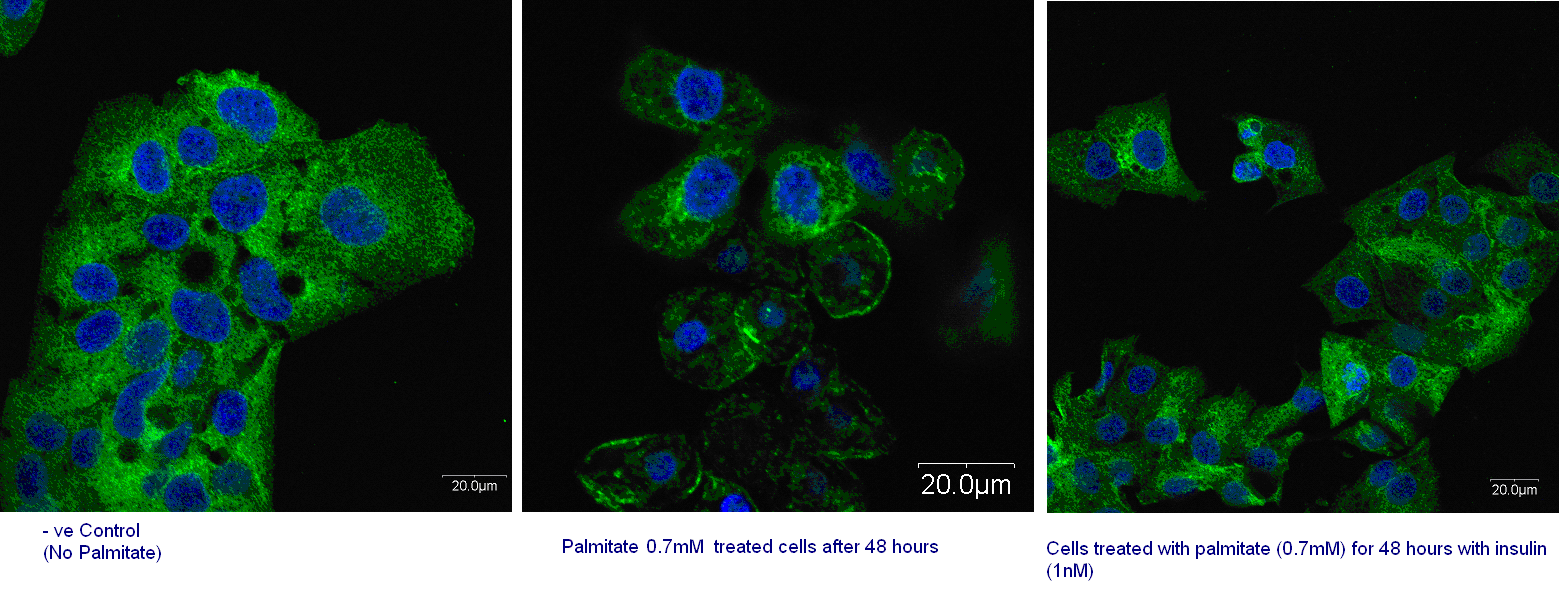
plaque. Figure 1 shows the effect of palmitate on
cellular expression of DSP. The cells treated with palmitate
show a significant decrease in DSP expression as compared to untreated control
cells. On the other hand, cells grown on insulin containing medium subsequent
to palmitate treatment restored some of the DSP
expression. Treatment with palmitate has been shown
to affect cellular adherence and cytoskeletal
structure in hepatocytes, although the exact
mechanism and whether DSP is involved in mediating these processes was not
known (Swagell et al, 2005). This opens a possible
mechanism by which palmitate could lead to the
development and progression of liver disease, i.e. non-alcholic
steatohepatitis (NASH) and hepatocellular
carcinoma (
Figure1
cellular expression of DSP in three
conditions, including control, palmitate, and palmitate plus insulin In contrast to synergy analysis, a network reconstructed
from differential correlation was unable to identify DSP as a being important
to lipotoxicity. In summary, our analysis recovered
known mechanisms, as well as revealed novel target genes
involved in the induction of lipotoxicity for further
investigation. References Swagell, C., Henly, D.,
Morris, C.P. Expression analysis of a human hepatic cell line in response to palmitate. Biochem. Biophys. Res. Commun. (2005) 328, 432-441. Chidgey, M., Dawson, C. Desmosomes:
a role in cancer? British Journal of Cancer (2007) 96, 1783-1787.