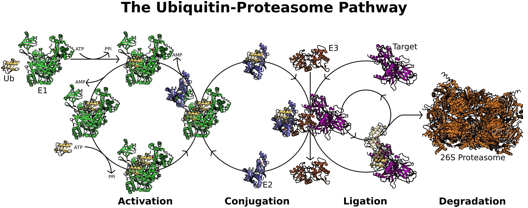
Ubiquitination, the post-translational attachment of the mere 76 amino-acid protein ubiquitin
to other proteins, regulates a vast array of diverse eukaryotic cellular processes, including protein
degradation by the 26S proteasome for which the process is best known. Three steps comprise
the ubiquitin pathway: activation, conjugation, and ligation. The E1 activates ubiquitin through
formation of a thioester bond with the latter's C-terminal glycine. The E2 binds the E1 and
acquires ubiquitin through a transthioesteriÞcation reaction. Though charged with ubiquitin, E2s
themselves are incapable of ubiquitinating a target protein. Instead, the charged E2 binds an E3.
Binding the target protein, the E3 acts as both an adaptor that brings the E2 and target substrate
together and a catalyst in ubiquitin's formation of an iso-peptide bond with the ϵ-amino group of
one of the substrate's lysine residues. Subsequent rounds can form chains of ubiquitin on the target
protein. Proteins with K48-linked polyubiquitin chains of at least four monomers are marked for
degradation by the 26S proteasome.
Recently, investigators have looked to the ubiquitin-proteasome system to rapidly degrade pro-
teins for protein knockdown. Inciting degradation of speciÞc proteins will prove useful for basic
research in uncovering protein function. With the pace of genomic sequencing accelerating, the
need to develop high throughput tools to characterize the proteome is growing. The approach may
also prove useful therapeutically in the treatment of cancer or other diseases where protein expres-
sion needs to be regulated. Most researchers have worked with redirecting E3 ubiquitin ligases to
new substrates. Proteolysis-targeting chimeric molecules (Protacs) consist of two chemical moieties
bound together by a carbon-chain linker. The E3 binds the Þrst moiety and the protein of interest
binds the second. Because of their close proximity, the E3 ubiquitinates the new target and the
latter is subsequently degraded [6]. Zhang et al. created a chimeric βTrCP-E7N capable of degrad-
ing p107 [7]. βTrCP is a substrate-recognition subunit of a multimeric RING E3 ligase; E7N binds
p107, a non-natural substrate of the E3. Hatakeyama et al. developed a Max-CHIP fusion protein
capable of signiÞcantly reducing tumor growth in cells over-expressing the oncoprotein c-Myc [3].
CHIP is a RING E3, and Max forms a heterodimer with c-Myc. Colas et al. fused the HECT
domain of an E3 to an aptamer with affinity for Cdk2 [1]. Though Cdk2 was ubiquitinated, its
stability was unaffected.
Successes have been case speciÞc and generally required known binders of the protein of interest.
The lack of a high throughput method to redirect E3s limits the generality and utility of redirecting
E3s to degrade any protein of interest. Our goal is to develop a high throughput method to generate
variant E3 ubiquitin ligases capable of causing the degradation of speciÞc novel substrates in an
efficient manner. Additionally, our method would negate the need for a prerequisite binding partner
for the protein of interest. The novel E3s could be used to study effects of protein knockdown in
cells, to understand aspects of the ubiquitin system, and to treat disease.
Our method does not rely upon prior knowledge of a target protein's interactions and does
not require modiÞcation of the target protein. Instead, we construct a naive library of variant E3
ubiquitin ligases and select for those capable of ubiquitinating our protein of choice. In generating
a library, we localize mutations to the E3's target binding domain. Based on de novo predictions of
that domain from the Robetta server [4] and insight from current literature [5, 2], we will randomize
the amino acid sequence of two loops amidst a scaffold of alpha helices to create peptide aptamers.
Aptamers embody some features of antibodies and can bind with comparable Kd , yet they are
rather short peptides. This approach should allow great ßexibility in library enrichment without
substantially altering the structural integrity of the E3, which might compromise its function.
We are currently developing a plasmid display system to isolate those E3 ubiquitin ligase variants
able to effect ubiquitination of our target protein. This screen possesses strengths from both in
vivo and in vitro contexts. Ubiquitination occurs in vivo in Escherichia coli where we successfully
constructed a physiologically-relevant ubiquitination cascade with our candidate E3. Because E.
coli lacks an endogenous ubiquitination system and 26S proteasome, we may isolate speciÞc E3-
target interactions and monitor ubiquitination without product degradation. Large library sizes
are possible in E. coli, and in vivo ubiquitination reactions abrogate the need to purify individual
components. Panning occurs in vitro where we make use of well-characterized antibodies to select
for speciÞc types of ubiquitination. We may extend our selection past merely ubiquitinated product
to product ubiquitinated in a speciÞc way, such as with K-48 linked or K-63 linked polyubiquitin
chains. In this manner, we could not only generate E3s capable of recognizing novel substrates,
but also change the way in which an E3 ubiquitinates its target.
References
[1] P. Colas, B. Cohen, P. K. Ferrigno, P. A. Silver, and R. Brent. Targeted modiÞcation and
transportation of cellular proteins. PNAS, 97:13720–13725, 2000.
[2] J. Dong, F. Xiao, F. Fan, L. Gu, H. Cang, G. B. Martin, and J. Chai. Crystal Structure of the
Complex between Pseudomonas Effector AvrPtoB and the Tomato Pto Kinase Reveals Both
a Shared and a Unique Interface Compared with AvrPto-Pto. The Plant Cel l, 21:1846–1859,
June 2009.
[3] S. Hatakeyama, M. Watanabe, Y. Fuji, and K. I. Nakayama. Targeted Destruction of c-Myc by
an Engineered Ubiquitin Ligase Suppresses Cell Transformation and Tumor Formation. Cancer
Research, 65:7874–7879, Sept. 2005.
[4] D. E. Kim, D. Chivian, and D. Baker. Protein structure prediction and analysis using the
Robetta server. Nucleic Acids Research, 32:526–531, 2004.
[5] T. R. Rosebrock, L. Zeng, J. J. Brady, R. B. Abramovitch, F. Xiao, and G. B. Martin. A
bacterial E3 ubiquitin ligase targets a host protein kinase to disrupt plant immunity. Nature,
448:370–374, July 2007.
[6] K. M. Sakamoto, K. B. Kim, A. Kumagai, F. Mercurio, C. M. Crews, and R. J. Deshaies. Pro-
tacs: Chimeric molecules that target proteins to the Skp1CullinF box complex for ubiquitination
and degradation. PNAS, 98:8554–8559, 2001.
[7] J. Zhang, N. Zheng, and P. Zhou. Exploring the functional complexity of cellular proteins by
protein knockout. PNAS, 100:14127–14132, 2003.