Wednesday, 2 November 2005 - 2:10 PM
357f
Probing the Adhesion Force between E.Coli and Modified Silicone Rubber Surfaces
Ting Cao1, Haiying Tang1, Anfeng Wang1, Xuemei Liang1, Gregory W. Auner2, Steven O. Salley3, and K. Y. Simon Ng1. (1) Department of Chemical Engineering and Materials Science, Wayne State University, 5050 Anthony Wayne Dr., Detroit, MI 48202, (2) Department of Electrical and Computer Engineering, Wayne State University, 5050 Anthony Wayne Drive, Detroit, MI 48202, (3) Wayne State University, 5050 Anthony Wayne Dr., Detroit, MI 48202
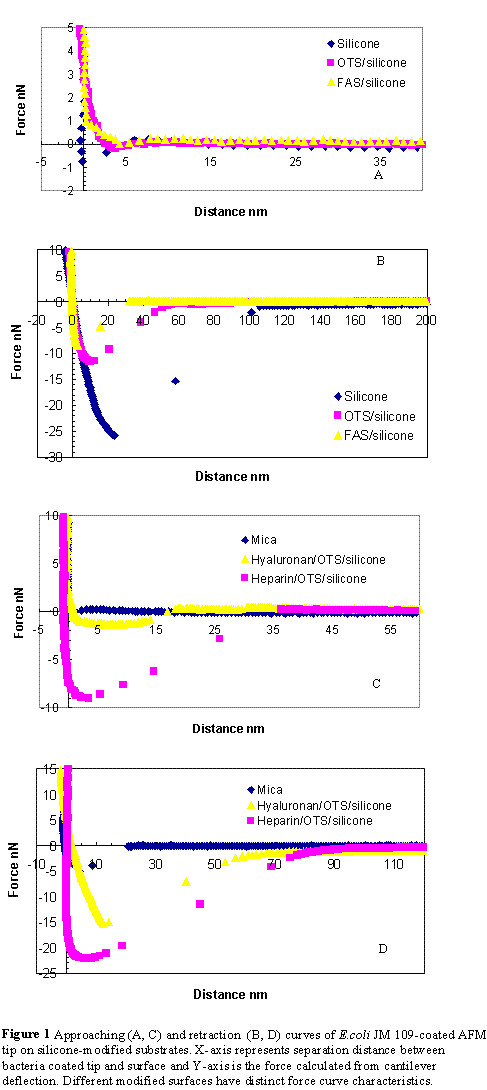
E.Coli JM 109 were immobilized to a standard Atomic Force Microscopy (AFM) probe. Both approach and retraction force curves were obtained and utilized to describe the extent of bacterial interaction with modified silicone surfaces. Scanning Electron Microscopy (SEM) photomicrography was also preformed. Figures 1 A) and C) show the interaction between bacteria and substrates during their approaching period, whereas, Figure 1 B) and D) exhibit the force needed to detach bacteria from surfaces. Results from both AFM and SEM indicate that FAS coated silicone shows a better bacterial resistant than silicone. Conversely, heparin treated silicone attracted more bacteria than any other surfaces. These techniques for sensing bacterial interactions and adhesion can provide a better understanding of the effects of surface composition on cell-material interaction forces and may be helpful in the future design of novel biomaterial surfaces.
See more of #357 - Imaging of Surfaces (01C11)
See more of Engineering Sciences and Fundamentals
See more of The 2005 Annual Meeting (Cincinnati, OH)