Thursday, 3 November 2005 - 10:04 AM
449f
The Properties of a Series of Isolated Low Molecular Weight Peptides from Phanerochete Chrysosporium in Decomposition of Lignin
Ming Hu, Xuemei Lu, Weichan Zhang, and Peiji Gao. State Key Laboratory of Microbial Technology, Shandong University, Jinan, China
In our study, a series of low-molecular-weight peptides named Pc factor was purified from P. chrysosporium, which could oxidize phenolic lignin-model compound and reduce Fe3+ to Fe2+. The redox property of Pc factor might play an important role in the early stage of wood degradation.
Isolation and purification of Pc factor
The crude extracellular enzyme solution of P. chrysosporium ME-446 ATCC 34541 was ultrafiltered (cut off 5kDa). The filtered components (<5kDa) were lyophilized, and applied to a Sephadex G-10 column for purification. The redox activity fractions were pooled and further purified on HPLC TSK-GEL G2500PW column.
Structure detection
The purified Pc factor was identified as a series of peptides with similar structures by MALDI-TOF (matrix assisted laser desorption ionization - time of flight) and amino acid analysis. The molecular mass of Pc factor varied 0.5 to 1kDa. According to MALDI-TOF, and the molecular weight margins between the components were 113.04 (Ile/Leu) and 150.77 (Cysteine oxidized). Cysteine was probably correlative with the redox activity of Pc factor. These results indicated Pc factor was a series of analogical peptides.
Properties of Pc factor
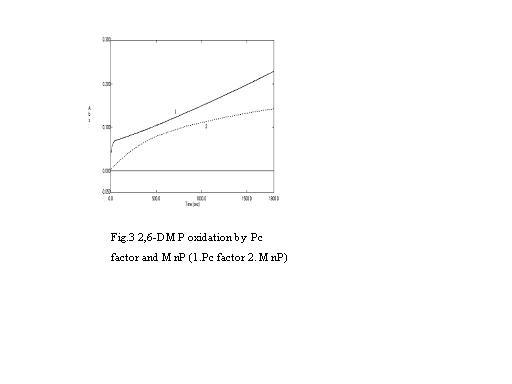
Pc factor could oxide phenolic lignin-model compound 2,6-DMP (2,6-dimethoxyphenol) in the absence of Mn2+ and H2O2 (Figure), and reduce Fe3+ to Fe2+. Pc factor could chelate Fe3+. No hydroxyl radical had even been detected with Pc factor by TBA (thiobarburic acid) and KTBA (2-keto-4- thiomentylbutyric acid) method. Pc factor had very high thermostability. No obvious redox activity was lost at 100°C for 30 min.
Conclusion
Our research showed that Pc factor was a series of analogical peptides with distinct redox property. It was quite different from other LMW (low molecular weight) factors described previously on the low molecular weight, special oxidative activity and high thermostability. Further investigation on the interaction between Pc factor and ligninolytic enzymes and the function of Pc factor in lignin biodegradation are currently in progress.
See more of #449 - Biological Conversions and Processes for Renewable Feedstocks II (T7009)
See more of Topical 7 - Envisioning Biorefineries
See more of The 2005 Annual Meeting (Cincinnati, OH)