Friday, 4 November 2005 - 9:00 AM
586d
An Electrochemical Impedance Spectroscopy Study of Chloride and 3-Mercapto-1-Propanesulfonic Acid Interactions in Acidic Copper Electroplating Bath
Hung-Ming Chen1, Satish J. Parulekar1, and Alan Zdunek2. (1) Illinois Institute of Technology, 10 W. 33rd St., Chicago, IL 60616, (2) American Air Liquide, 5230 S. East Ave, Countryside, IL 60525
Along with the decrease in
the critical dimension of semiconductor chips, there are strong demands for
higher electron mobility metal interconnects to permit faster signal
transmission and reduce RC delay of the integrated circuit (IC). In addition,
the metal deposition process must be able to create void-free deposits in the
chip interconnects, which could be as narrow as 90 nm. Replacing the
traditional aluminum interconnect with copper could reduce the wiring
resistance by as much as 45%. The void-free filling capability of copper
electrochemical deposition (ECD) on transistor level interconnects was first
demonstrated by IBM in 1990 with damascene patterns1. The void-free
deposition phenomena is often referred to as superfilling or superconformal
deposition and is enabled by several additives at optimal concentration ranges
and proper processing conditions.
Chloride ions are the most
common additive in copper plating chemistries and their adsorption affinity
onto copper surfaces has been extensively studied with techniques such as
in-situ STM, Auger electro spectroscopy, low-energy electron diffraction
(LEED), and Auger depth profiling2,3. Ehlers et al.3
immersed the annealed Cu (100) into a 1 mM HCl solution and observed a chloride
surface coverage of 0.5 by LEED pattern. Auger peak height ratios versus
emersion potential also showed that the potential dependent chloride adsorption
film on copper surface becomes labile at more negative potentials. While
chloride presents at high concentration in the electrolyte, CuCl layer starts
to form at copper anode surface2 due to the anodic polarization and
it would dissolved in H2SO4 bases on a Ksp
value of 1.02x10⁻⁶ M. Trace amounts of chloride ions at the
parts-per-million level in the electrolyte are able to catalyze the Cu2+/Cu+
reaction by changing the reaction mechanism from an outer-sphere reaction
(water-water bridge) to an inner-sphere reaction (chloride bridge)4,
and therefore the copper deposition potential becomes depolarized5.
An adsorbed thin layer of CuCl consequently forms on the cathode surface.
3-mercapto-1-propanesulfonic
acid (MPS) and disodium bis(3-sulfopropyl)disulfide (SPS) are well-known as
accelerators or brighteners in the electrochemical deposition bath chemistry.
Although SPS is the dimer form of MPS, there is no direct experimental evidence
for reduction of SPS to MPS6. These two brightening agents are
unstable at either open circuit potential or in electrolysis condition7.
The instability of MPS and SPS is caused by the dissolved oxygen in the
electrolyte7,8, Cu2+ ions from electrolyte, Cu+
ions from metallic copper surface6,
and incorporation of sulfur atom into copper deposition layer at cathode8.
The complexation reaction between copper ions and accelerating agent is the key
step which leads to the brightening of electrodeposited copper.
Electrochemical impedance
spectroscopy was used to study the role of chloride ions in the presence of
MPS. The electrolyte were bubbled with nitrogen prior measurements and
blanketed with nitrogen during measurements preventing back diffusion of
oxygen. These measurements were conducted at 25 oC in a temperature
controlled cell. We observed an increase in double layer capacitance and
reduced charge transfer resistance at high to medium impedance scan frequency
with the addition of chloride ions; however, the MPS does not show significant
effect in this frequency region. The increase of deposition current does not
occur until the addition of chloride and it became more significant at
potentials more negative than -150 mV. From the ac impedance measurement
results in Figure 1, we observe a change in the spectra when chloride present
in the solution with MPS at low frequency. There are two frequency regions of
interest; 5 to 0.5 Hz and 0.5 to 0.01 Hz corresponding to the sensitivity of
chloride ions and MPS, respectively. The chloride ions at the electrode surface
help to facilitate bridging these MPS molecules and an increase in deposition
current is thereafter observed.
Reference
- P. C. Andricacos, Interface, Winter, 32 (1999).
- C. B. Ehlers and I. Villegas and J. L. Stickney, J. Electroanal. Chem., 284, 403 (1990).
- W. H. Li and Y. Wang and J. H. Ye and S. F. Y. Li, J. Phys. Chem. B, 105, 1829 (2001).
- Z. Nagy and J. P. Blaudeau and N. C. Hung and L. A. Curtiss and D. J. Zurawski, J. Electrochem. Soc., 142, L87 (1995).
- J.D. Reid and A.P. David, Plating and surface finishing, 74, 66 (1987).
- P. M. Vereecken and R. A. Binstead and H. Deligianni and P. C. Andricacos, IBM J. Research and Development, 49, 3 (2005)
- J. P. Healy and D. Pletcher and M. Goodenough, J. Electroanal. Chem., 338, 167 (1992).
- Eric G. Eddings and Terry A. Ring, PC FAB, Dec, 34 (1990).
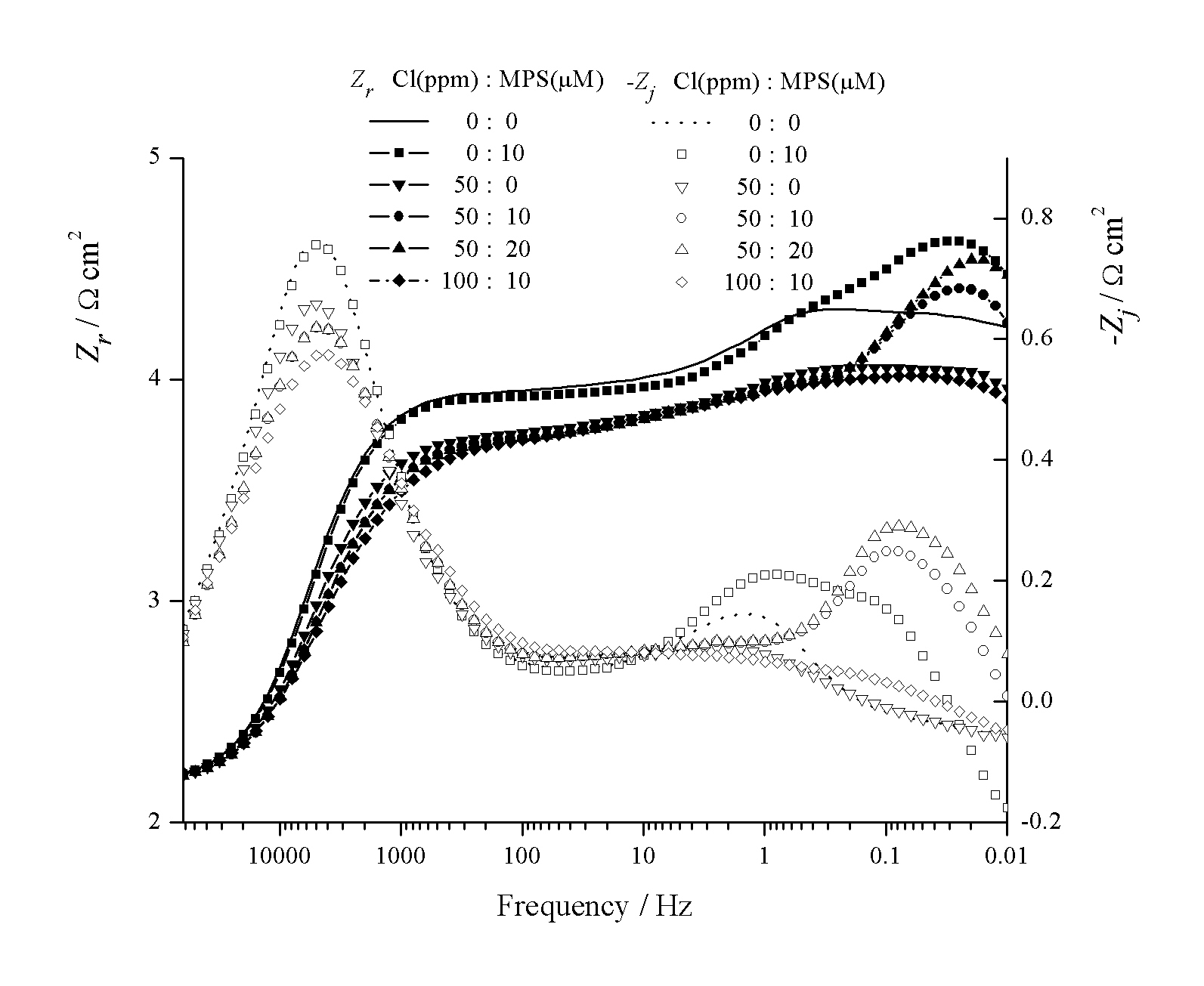
Figure 1. EIS measurements of BE with various concentration levels of chloride and MPS. Rotation speed of RDE is 2000 rpm.
See more of #586 - Reaction Kinetics in Electronic Materials Processing (08E04)
See more of Materials Engineering and Sciences Division
See more of The 2005 Annual Meeting (Cincinnati, OH)