Tuesday, 1 November 2005 - 5:00 PM
277e
Polymeric Thin Films as Templates and Devices in Microoptics Created Via Reaction-Diffusion
Christopher J. Campbell, Eric Baker, Marcin Fialkowski, and Bartosz A. Grzybowski. Dept of Chemical and Biological Engineering, Northwestern University, 2145 Sheridan Rd/TechE136, Evanston, IL 60208
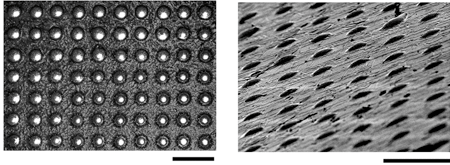
A method we have developed, called Wet Stamping (WETS), uses hydrogel stamps patterned in bas relief and soaked in a solution of a desired reagent(s) to deliver this reagent(s) onto a substrate made of a polymeric thin film. This reaction-diffusion method overcomes many limitations of soft-lithographic techniques, e.g. reagents can penetrate into and modify the bulk of the substrate. Control over reaction geometries and fluxes results in qualitatively new structures from familiar reaction systems. Salt precipitation via reaction-diffusion processes are used to produce from two-dimensional patterns a three-dimensional optical template. Examples of diffraction gratings, curvilinear microlenses, and Fresnel lenses made in thin polymer films will be presented. (Below) Optical micrograph of an array of circularly symmetric depressions (left), and a SEM image of the corresponding array of microlenses on the surface of a PDMS replica. The scale bars correspond to 200 mm.
Web Page: dysa.northwestern.edu
See more of #277 - Polymers as Functional Components of Micro- and Nanodevices (TH003)
See more of Topical H – Biomedical Applications of Nanotechnology (Bionanotechnology)
See more of The 2005 Annual Meeting (Cincinnati, OH)