Thursday, 3 November 2005 - 2:00 PM
505e
First Principles Based Kinetic Modeling of Industrial Catalytic Reactions: Hydrogenation of Mono Aromatic Compounds
Mark Saeys1, Joris W. Thybaut2, M.F. Reyniers3, Matthew Neurock4, and Guy B. Marin2. (1) Chemical and Biomolecular Engineering, National University of Singapore, 4 Engineering Drive 4, Singapore 117576, Singapore, (2) Laboratorium voor Petrochemische Techniek, Universiteit Gent, Krijgslaan 281, blok S5, Gent, 9000, Belgium, (3) Laboratorium voor Petrochemische Techniek , Ugent, krijgslaan 281 S5, Gent, 9000, Belgium, (4) University of Virginia, 102 Engineers' Way, Charlottesville, VA 22904-4741
Introduction
The development and optimization of chemical processes requires accurate reaction models that are applicable over a wide range of process conditions. For many years the construction of kinetic models for industrial catalytic reactions has been largely based on indirect experimental observations and chemical intuition and often does not take into account the elementary step kinetics. This can limit the applicability of the model to a restricted range of process conditions. For complex, multistep catalytic reactions such as benzene hydrogenation, a large number of kinetic models can be proposed based on various model hypotheses, each containing a significant number of kinetic and thermodynamic parameters. This makes model discrimination and parameter estimation based on experimental data very difficult. In this work, we explore the capabilities of first principles modeling as a new tool for the development of reaction models for industrial catalytic reactions. The catalytic hydrogenation of aromatics of Pt was selected as a test case in view of its relevance for a variety of industrial processes, such as hydrocracking, hydrogenation, catalytic reforming and nylon production. In addition, the multistep reaction mechanism poses a challenge to kinetic modeling. To validate the first principles based kinetic model, lab scale intrinsic kinetic data were collected for toluene hydrogenation over a 0.5 wt% Pt/ZSM-22 hydrocracking catalyst1 and an industrial hydrocracking unit was simulated. Method
First principles calculations were used to construct the kinetic model and to determine the kinetic and thermodynamic parameters. Relativistic density functional theory with the Becke Perdew functional and a Slater double zeta quality basis set was applied as implemented in ADF2. The catalyst was represented by a Pt(14,8) cluster model with the Pt-Pt distance constrained at the bulk value of 277 pm. It was found that this approach yields reasonably accurate values for adsorption and activation energies, both in comparison with experimental and periodic slab calculations3.
Toluene hydrogenation was studied in a gas phase continuous stirred tank reactor1. Nitrogen was used to vary the H2 and toluene partial pressures under which conversion was measurable and not transport limited as confirmed by Weisz modili of about 10-2. The concentration of active sites Ct was calculated from the number of accessible Pt atoms and amount to 0.8 10-2 mol kgcat-1.
Results
Model construction. A number of fundamental concepts for the analysis of catalytic reaction mechanisms was introduced by Boudart3. These concepts, i.e. catalytic cycle, rate determining step (RDS) and most abundant reaction intermediate (MARI), help in the construction of Langmuir-Hishelwood-Hougen-Watson (LHHW) type kinetic models. Based on the ab initio reaction path analysis3, the following hypotheses could be formulated:
(i) the chemisorption of the reactants hydrogen and molecular aromatic is competitive
(ii) desorption of the hydrogenated product is irreversible because of the low adsorption energy
(iii) hydrogenation follows a single dominant reaction path where the addition of the fifth hydrogen is the rate determining step. Along the dominant reaction path the activation energies for every step are at least 20 kJ/mol lower than for any of the competing paths branching from the dominant path3. Along the dominant reaction path, the activation energy for the fifth hydrogenation step, 104 kJ/mol, is significantly higher than the activation energy for any of the other steps, which are between 72 and 88 kJ/mol. Assuming similar pre-exponential factors, the fifth step can therefore be considered rate determining.
(iv) the chemisorbed reactants, hydrogen and aromatic, are the thermodynamic sink of the reaction path and can be considered Most Abundant Reaction Intermediates (MARI)
Based on these
hypotheses, a LHHW kinetic model was derived, enabling easy interpretation and
evaluation of the parameters appearing in the rate equation:
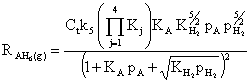 (1)
where pA
and pH2 are the reactant partial pressures. Taking into account the
temperature dependency, nine parameters appear in the rate equation: the
concentration of active sites Ct, which was obtained experimentally,
the rate coefficient of the rate determining step k5 (2 parameters),
the product of the equilibrium coefficients for the surface reactions,  (2
parameters), and the adsorption coefficients for toluene, KA, and
for hydrogen, KH2 (2 parameters each).
All kinetic and
thermodynamic parameters were obtained from first principles, combining the DFT
calculations with statistical mechanics, and are listed in Table 1. The
hydrogen adsorption enthalpy is strongly coverage dependent (e.g. ref. 5).
Instead of assigning the low coverage DFT value of –94 kJ/mol, the hydrogen
adsorption enthalpy was treated as an adjustable parameter, DHads(H2). The reaction
enthalpy for the product of the equilibrium coefficients,
 ,
also varies with the hydrogen adsorption enthalpy since 4 adsorbed hydrogen
atoms are consumed in going from the reactants A* and 4 H* to the intermediate AH4*.
The kinetic model (1) was implemented in a reactor model and the coverage dependent hydrogen chemisorption enthalpy was optimized to accurately describe lab scale experimental data for gas phase hydrogenation of toluene. The resulting value of –63.6 ± 0.9 kJ/mol falls between the high and low coverage values, consistent with a simulated surface coverages between 55 and 85%. As shown in the parity diagram, Figure 1, the ab initio based LHHW model captures the main trends in the reaction rates. The model predicts reaction orders for the inlet partial pressure of hydrogen and toluene ranging from 1.6 to 2.2 and from -0.3 to +0.7 respectively, in agreement with experimental values which range from 1.3 to 1.8 and from -0.3 to +0.3 respectively. Also the experimentally observed maximum in the reaction rate versus temperature is predicted by the ab initio model.
Industrial hydrocracker simulation. The first principles based kinetic model was implemented in a reactor model for the simulation of an industrial hydrocracker6. The reactor is operated in trickle bed regime with co-current downflow of the vapor and the liquid phase. The reactor model accounts for possible mass and heat transfer gradients at the vapor liquid interface and internal mass transfer gradients in the catalyst.
The simulation indicates that the hydrogenation of aromatics occurs mainly in the first part of the reactor. This leads to hot spot formation and liquid phase hydrogen depletion in the first decimeters of the reactor, Figure 2. The higher the aromatic content, the more pronounced these effects. For the highest aromatic content, i.e., higher than 15%, a regime is established in which the interphase hydrogen mass transfer becomes rate limiting. This is evident from the development of a shoulder in the liquid phase temperature profile and from the delayed recovery of the liquid phase hydrogen flux from the initial depletion, Figure 2.
Conclusion
A fundamental LHHW kinetic model for the hydrogenation of monoring aromatics over platinum catalysts was constructed, based on detailed first principles density functional calculations. The model parameters were obtained from the first principles calculations and from statistical mechanics. Our first principles based kinetic model rather accurately describes lab scale kinetic data for the hydrogenation of toluene over a 0.5 wt% Pt/ZSM-22 catalyst. The incorporation of this kinetic model in the simulation of an industrial hydrocracker revealed effects such as hot spot formation and liquid phase hydrogen depletion near the entrance of the reactor. For higher aromatic contents hydrogen interphase mass transfer becomes rate limiting.
References
[1] J. W. Thybaut, M. Saeys, G. B. Marin, Chem. Eng. J. 90 (2002) 117.
[2] G. te Velde, F. M. Bickelhaupt, E. J. Baerends, C. Fonseca Guerra, S. J. A. Van Gisbergen, J. G. Snijders, T. Ziegler, J. Comp. Chem. 22 (2001) 931.
[3] M. Saeys, M.-F. Reyniers, M. Neurock, G. B. Marin, J. Phys. Chem. B 109 (2005) 2064.
[4] Boudart, M., Djéga-Mariadassou, G., Kinetics of Heterogeneous Catalytic Reactions, Princeton University Press: Princeton (1984)
[5] S.G. Podkolzin, R. Alcala, J.J. de Pablo, J.A. Dumesic, J. Phys. Chem. B 106 (2002) 9604.
[6] G.G. Martens, G.B. Marin, AIChE J. 47 (2001) 1607.
Table 1 First principles derived kinetic and thermodynamic parameters for the LHHW rate equation (1).
|
Parameter |
Pre-exponential factor |
Enthalpy/activation energy (kJ/mol) |
|
Ct |
0.8×10⁻² mol/kgcat |
/ |
|
k5 |
5 1011 s–1 |
103.5 |
|
|
0.0625 |
–74.1 – 2•DHads(H2) |
|
KA |
2.5×10⁻¹¹ Pa–1 |
–70.6 |
|
KH2 |
2.7×10⁻⁹ Pa–1 |
DHads(H2) |

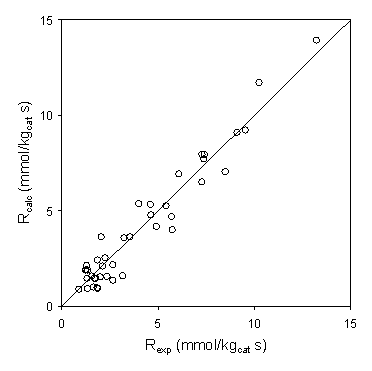
Figure 1.
Parity diagram for the methylcyclohexane outlet flow rate; Line: Experimental,
Dots: Calculated based on first principles kinetic model equation (eq. 1) and
parameters from Table 1.
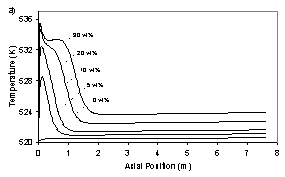
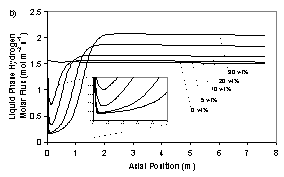
Figure 2. Effect of the total aromatic feed content on: a) the liquid phase temperature and b) the liquid phase hydrogen molar flux as a function of the axial position in the reactor at 520 K, 12 MPa and a hydrogen to hydrocarbon ratio of 25 for an LHSV of 4.6 mL3 (m3cat h)-1.
See more of #505 - Industrial Applications of Computational Chemistry and Molecular Simulation I (21004)
See more of Computational Molecular Science and Engineering Forum
See more of The 2005 Annual Meeting (Cincinnati, OH)