Tuesday, 1 November 2005 - 5:15 PM
271i
Mill Scale-Steam Reforming: a Novel and Inexpensive Route of Hydrogen Generation
Sathees Kumar Kesavan and Abdul-Majeed Azad. Department of Chemical Engineering, University of Toledo, 3052 Nitschke hall, 2801 W.Bancroft st., Toledo, OH 43606
Hydrogen has been touted to be the ideal fuel for PEMFCs. Unfortunately, it is not as abundant a commodity in nature as oxygen and nitrogen. Therefore, the question of its storage and supply arises only after it is produced in large enough quantity so as to cater to the need of its use. In the light of the serious economic constraints and safety concerns associated with production, storage and supply of gaseous hydrogen, one needs to find ways and means of generating, storing, transporting and supplying hydrogen to the end use port - in more reversible, much simpler and far safer ways.
An economically viable and environment friendly method of generating hydrogen is by the reaction of certain metals with steam, also appropriately called ‘steam-metal reforming'. The reaction, 3 Fe + 4 H2O → Fe3O4 + 4 H2 which occurs at ~ 600ºC, has been known for a long time and has recently been described as one of the ways of generating hydrogen [1]. The reverse reaction could be viewed as a hydrogen storage scheme. However, the kinetic of metal oxidation (forward) and oxide reduction (reverse) in a cyclic fashion has to be significantly improved to mitigate sintering and coarsening of iron and iron oxide particles during repeated redox cycles [2-3].
We report an effective technique of producing hydrogen (in a way consistent with the criteria listed above: environment, availability and price) by using the so-called ‘mill-scale' waste from steel industry. The mill-scale is a hard brittle coating of several distinct layers of iron oxides formed during the processing of steel. It is magnetic in nature (Fe3O4 predominantly) with iron content ranging between 66 to 88%.
In order to establish the feasibility of hydrogen production and recycling of the iron oxide waste on a laboratory scale, the mill-scale was successfully and quantitatively (~100%) reduced to elemental iron both via H2 and carbothermic reduction. In an attempt to eliminate the use of high temperature and H2 gas and, the CO/CO2 emission a solution-based technique has been devised resulting in the formation of nanoscale elemental iron particles from mill-scale powder near room temperature, which could be used directly in metal-steam reforming process to produce H2. Some preliminary results of this investigation will be presented.
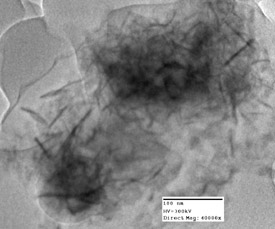
Fig. 1. TEM image of iron particles obtained from steel industry waste by room temperature processing.
Scale bar: 100 nm
References:
1. K. Otsuka , T. Kaburagi, C. Yamada and S. Takenaka, in R.D. Venter, T.K Bose, N. Veziroglu (Eds.), Proceedings of the 14th World Hydrogen Conference, Montreal, Canada, (Session A1.9 - Storage and Material systems I) 2002.
2. K. Otsuka, T. Kaburagi, C. Yamada and S. Takenaka, J. Power Sources, 122 (2003) 111.
3. S. Takenaka, T. Kaburagi, C. Yamada, K. Nomura and K. Otsuka, J. Catal. 228 (2004) 66.
See more of #271 - Nanomaterials and Devices for Energy Applications (TF004)
See more of Topical F – 5th Topical Conference on Nanoscale Science and Engineering
See more of The 2005 Annual Meeting (Cincinnati, OH)