Thursday, November 8, 2007 - 10:10 AM
546e
Template Free, Large Scale Synthesis Of Metallic Cobalt Nanowires
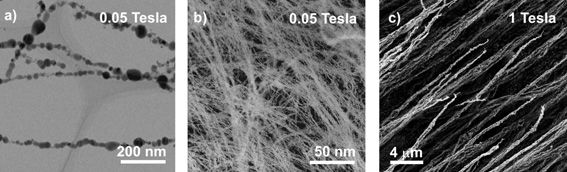
The present contribution investigates the preparation of ferromagnetic nanowires at large production rates in a one-step gas phase process. Applying an external magnetic field on a metallic cobalt nanoparticle-loaded gas stream resulted in the formation of self aligned metallic cobalt nanowires of 20-50 nm diameter (Figure 1(a)). This template-free, continuous and rapid production method afforded nanowires with an aspect ratio of over 1000 (length / diameter, Figure 1(b)) at a production rate of over 30 g h-1. At higher magnetic fields the metallic nanowires formed bundles with distinctive parallel orientation (Figure 1(c)). Since the anisotropic agglomeration of the metal nanoparticles takes place at elevated temperature, the as formed magnetic nanowire is consolidated by sintering of the metal particles.
Fig. 1: Transmission electron micrograph of air stable metallic nanowires (a). An overview (SEM image, (b)), corroborated the exclusive formation of large amounts of template free nanofibers. The application of a stronger magnetic field resulted in thicker self aligned bundles of nanowires (c).
References:
E.K. Athanassiou, P. Grossmann, R.N. Grass and W.J. Stark, Nanotechnology, 2007, 18(16), 165606.
R.N. Grass, M. Dietiker, C. Solenthaler, R. Spolenak, W.J. Stark, Nanotechnology, 2007, 18(3), 035703.
See more of Nanoscale Science and Engineering Forum
See more of The 2007 Annual Meeting