Wednesday, November 7, 2007 - 9:45 AM
374d
Generating and Evaluating Entrainers for Extractive Distillation Processes in a Systematic Synthesis Framework
To systemize the process design and to deal with the large number of candidate flowsheets, a framework for the synthesis of extractive distillation processes is proposed. In this framework the entrainer choice and the other degrees of freedom, such as entrainer flow rate, reflux ratio and number of column trays are fixed in successive steps to design the cost optimal process.
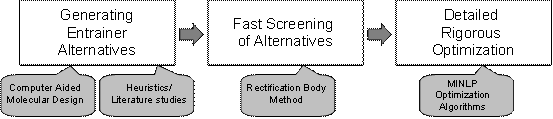
The proposed synthesis framework depicted in fig. 1 is essentially a three step process. The flowsheet synthesis starts with the generation of entrainer candidates in the first step. While several heuristics have been developed to find suitable entrainers for a given azeotropic mixture, additional entrainer candidates are designed here through Computer-Aided Molecular Design (CAMD) [Harper and Gani 2000]. This allows the generation of feasible entrainer candidates systematically based on thermodynamic group contribution methods.
For the evaluation of these entrainer candidates a number of methods, such as the selectivity at infinite dilution have been proposed. Instead of these rules of thumb the Rectification Body Method (RBM) for extractive distillation is used in the framework to further screen the selected set of entrainers based on minimum energy demand of the columns and minimum entrainer flowrates. In this screening step the minimum entrainer flowrate is determined from the analysis of the nonlinear pinch equations and the minimum energy demand from the tailored shortcut models [Brüggemann & Marquardt, 2004].
Once the entrainer choices have been narrowed down to two or three candidates with these shortcut models, a rigorous MINLP optimization is started. Here the entire process is optimized with respect to an economic merit function. In this last step the optimal number of stages, the optimal feed stage, reflux policies and the optimal entrainer flowrate are determined. Information from the shortcut step can be used for the initialization of the MINLP optimization model [Kossack et al. 2006], which greatly increases stability and convergence.
The separation of the azeotropic mixture of acetone/methanol is used as an illustrative case study for the proposed synthesis framework. The results obtained from the different screening rules such as selectivity and the RBM are compared with the results obtained from the MINLP step and advice on criteria for suitable entrainer choices are given.
This work was funded by the Deutsche Forschungsgemeinschaft (DFG) under grant MA 1188/26-1.
References
Harper, P.M., and Gani, R., (2000) Computers and Chemical Engineering, 24, 677-683.
Brüggemann, S., and Marquardt, W., (2004) AIChE Journal, 50, 1129-1149.
Kossack, S., Kraemer, K., and Marquardt, W., (2006) Industrial & Engineering Chemistry Research, 45, 8492 - 8502.
See more of Computing and Systems Technology Division
See more of The 2007 Annual Meeting