Thursday, November 8, 2007 - 10:35 AM
549f
The Fusion Of Silicon And Enzymes: Smart Multifunctional Catalysts
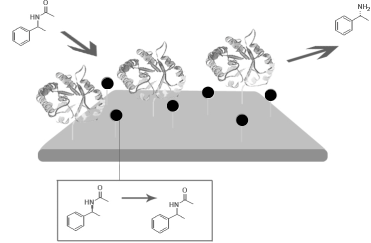
The immobilization of enzymes on semiconductor interfaces leads to an interesting and challenging field of research, since the properties of the biomolecules influence the surface properties of the semiconductors and vice versa. We present a powerful and versatile method for the covalent immobilisation of proteins to activated silicon surfaces by combining “classical” protein immobilization chemistries and silicon surface manipulation techniques, such as photochemical surface hydrosilylations, which leads to structured biofunctionalized surfaces. By broadening the method toolkit with structuring techniques, such as photopatterning and photolithography, patterned multifunctional catalyst arrays will be prepared. Besides the application as solid phase catalysts, these methods also open a route to the development of smart biosensors.
See more of #549 - Novel Catalytic Materials (08D02)
See more of Materials Engineering and Sciences Division
See more of The 2007 Annual Meeting
See more of Materials Engineering and Sciences Division
See more of The 2007 Annual Meeting