Thursday, November 8, 2007 - 4:50 PM
643e
Vapor Deposition of Condensation Polymers for Organic Electronics
Our major research objective is to apply vapor deposition polymerization (VDP) techniques to fabricate thin films of organic semiconductors. VDP is an alternative to melt-processing and solution processing of polymer films, and involves the co-evaporation of two or more reactive monomers onto a substrate under vacuum conditions. This technique offers a solventless process whereby film thickness can easily be modulated, conformal coatings can be achieved down to the nanometer length scale, and resulting coatings are free of defects associated with solvent casting. Over the past decade, full density, high performance polyimides, polyquinoxalines, and poly(oxadiazoles) have been prepared using VDP techniques. We have recently demonstrated that polybenzoxazole films (i.e. Zylon-like films) can be fabricated with high modulus (~12 GPa) and hardness (~ 0.6 GPa) values.1 Potential applications of these VDP films include dielectric packaging and passivation for electronics, and active layers (charge transport, recombination, and generation) in OLED and photovoltaic devices.
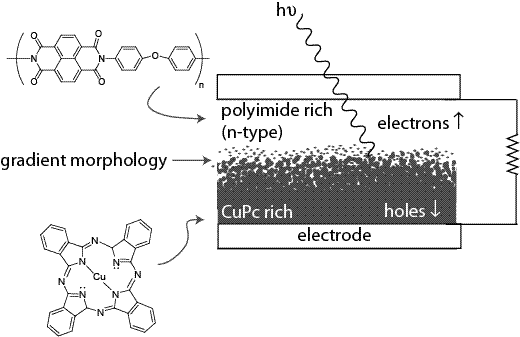
A new three-source CVD system has been designed and built to co-deposit naphthalene or perylene dianhydrides (NTDA or PTDA) and a diamine to form n-type polyimides, in the presence of copper phthalocyanine (CuPc), a p-type small molecule. Evaporation temperatures and operating conditions were first determined to produce smooth polyimide films. As-deposited films were studied using optical microscopy, FT-IR, and AFM techniques. Current studies are focused on co-depositing copper phthalocyanine (CuPc) into the bulk polyimide to form favorable microstructures for organic electronics (see figure), paying particular attention to morphology and the interpenetrating nature of the donor- acceptor constituents. For example, these studies could enable gradient morphologies (of p-type and n-type micro-phases) to increase the width of the charge recombination zone in OLED and/or enhanced charge injection.
1. Chen, X. C.; Anthamatten, M.; Harding, D. R. Macromolecules 2006, 39, (22), 7561-7565.
Web Page: www.che.rochester.edu/users/anthamat/research_CVD_photovoltaics.htm
See more of Topical 7: Polymers for Energy Applications
See more of The 2007 Annual Meeting