Wednesday, November 7, 2007 - 2:35 PM
419f
Preferential Oxidation Of Co On Pt-Nb2O5/Al2O3 Catalysts. Study Of The Nb Promotion Effect And Kinetic Analysis
Materials and Methods The 1%Pt/Al2O3 and 1%Pt/X%Nb-Al2O3 (X=1,5,10,20 is the niobium loading) catalysts were prepared by co-precipitacion of the metals (Pt, Nb) in a solution containing finely dispersed alumina. The 1%Pt/X%Nb-Al2O3 (X=30,50) catalysts were prepared by successive impregnation using ammonium niobium oxalate (Aldrich) and tetraammineplatinum (II) nitrate (Aldrich) as precursors. The 1%Pt/Nb2O5 was prepared by a micro-emulsion procedure. The reaction mixture had a composition of 0.8% CO, 0.8% oxygen, and 51% H2, with He as balance, and was added at a total flow rate of 195 cc/min. XPS and EXAFS/XANES techniques were use to characterize the catalysts, and DRIFTS to study CO adsorption on the catalyst.
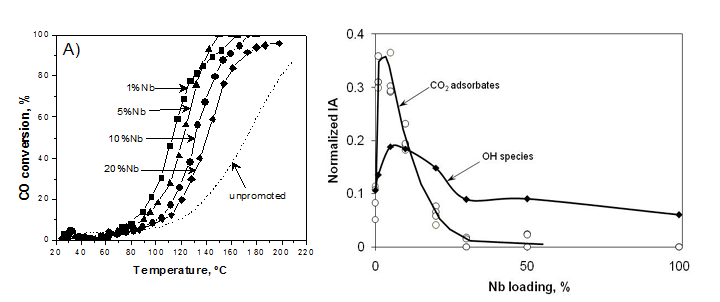
Results and Discussion The activity of platinum niobia-promoted catalysts was measured during the preferential oxidation of CO (PROX) in a hydrogen rich flow. The results show a unique effect of niobium as a catalyst, which can either acts as a promoter or as inhibitor depending on niobia content. The most interesting result occur when Pt is supported on bulk Nb2O5 in which case the CO activity is significantly inhibited. XPS results showed that increasing the niobia content increases the oxidation states of Pt and Nb affecting also their binding energies. These surface changes modify the strength of CO adsorbed on Pt as shown by DRIFTS, with CO weakly adsorbing when Pt is supported on bulk Nb oxide. Operando infrared results show a shift of the linear CO band frequency to higher values as Nb loading is increased, and this band appears to be an spectator species because it does not change as CO conversion increases. Operando EXAFS/XANES and ex-situ XPS results show that the reduced Pt Nb-promoted catalysts are in a partially Pt+2 oxidation state. In fact, in all the Nb-promoted catalysts, 40% of Pt remains as Pt+2 when pre-reduced in hydrogen at 250ºC, while unpromoted Pt/Al2O3 was completely reduced at the same temperature. The addition of a small amount of Nb promotes CO conversion on the 1%/Pt/A2O3 catalyst (Fig. 1A). 100% CO conversions were obtained at 170ºC on 1%Pt/5%Nb-Al2O3, whereas the un-promoted catalyst did not show full conversions below 200ºC. On the other hand when niobia was used as a support, 1%Pt/Nb2O5, the selectivity to CO under PROX conditions was significantly reduced but it was still able to maintain a high activity for hydrogen oxidation. Nb=O moieties are present at low Nb loadings and the increases in their signal with the increase in Nb suggest the formation of tri-dimensional Nb2O5 aggregates. We report here that the hydroxylation of the support has a maximum at low Nb loadings, which coincides with the capacity of the support of adsorbing carbonate-like species. In fact, the most active catalysts show the highest carbonate-like adsorption capacity, Figure 1B. Kinetic parameters are provided for the promoted Pt/5%Nb-Al2O3 and Pt/Al2O3 catalysts. In addition, a kinetic model is proposed, which suggests that carbonate-like species acts as a barrier for the spillover mechanism, which in turn benefits the selectivity of the catalysts.
Significance This work shows that small amounts of Nb promote the preferential oxidation of CO, helping to completely remove the CO from H2-rich stream at lower temperatures than the unpromoted Pt catalyst. Such catalysts could be applied to remove CO from H2-rich fuel streams feeding proton-exchange membrane fuel cells (PEMFC).
Figure 1. A) PROX results on 1%Pt/X%Nb-Al2O3, with X=1,5,10,20% of Nb loading. The dashed line corresponds to the unpromoted 1%Pt/ Al2O3 catalyst. B) DRIFTS normalized integrated absorbance between 4000 and 2500 cm-1 (OH species) and between 1800 and 1100 cm-1 (CO2 adsorbates) on the Pt/X%Nb-Al2O3 (X=0, 1, 5, 10, 20, 30, 50, and 100%) catalysts
Acknowledgments Companhia Brasileira de Metalurgia e Mineração, CBMM, and NSF CTS 92 00000 are gratefully acknowledged.
References 1. J.C. Amphlett, M.J. Evans, R.F. Mann, and R.D.Wier. Can.J.Chem.Eng., 63 (1985) p. 605. 2. E. Santacesaria, and S. Carra, Applied Catalysis, 5 (1983) p. 345. 3. R. Farrauto, S. Hwang, L. Shore, W. Ruettinger, J. Lampert, T. Giroux, Y. Liu, and O. Ilinich. Annu. Rev. Mater. Res., 33 (2003) p. 1.
See more of Catalysis and Reaction Engineering Division
See more of The 2007 Annual Meeting