Thursday, November 8, 2007 - 2:35 PM
595f
Time Dependent Uncertainties in Batch and Biological Processes and Optimal Control
Chemical, biochemical and pharmaceutical manufacturing often entails time-dependent or batch processes. Batch processing arises from the need to manufacture high value, low volume products with flexibility. The inherent dynamic nature of batch processes allows for their ability to handle variations in feedstock and product specifications and provides the flexibility required for multi-product or multi-purpose facilities. The applications of batch processes range from specialty chemical and pharmaceutical manufacturing to agricultural, food and consumer products and most recently the constantly growing spectrum of biotechnology enabled products (Korovessi and Linninger, 2006). However, it is this flexibility and the time dependent nature of batch processing, which causes challenging design and operational problems.
Uncertainties are inherent in batch processing due to changing feed composition, product specification, and multi-product or multi-purpose nature of plant. In batch processing industries such as pharmaceutical or specialty chemical industries, new compounds are commonly generated and new manufacturing processes are devised. In these circumstances, the availability of thermodynamic or kinetic data is often sparse and/or many a times the physical principles behind these new processes are not well understood.
For example, consider the case of emerging processes for biodiesel. Rape methyl ester (RME) is a form of biofuel which is regarded as an alternative to petroleum based diesel. For the production of this biofuel, methanol is used as a solvent and it is recovered by distillation at the end of the process. Figure 1 shows the results of rigorous simulation for the separation of methanol from biodiesel in a batch distillation column (Ulas and Diwekar, 2004). Since no data for the vapor–liquid equilibrium is available for the separation of RME from methanol, the individual components or the fatty acids which constitute the rape methyl ester are lumped to predict the phase equilibrium in this simulation. This figure demonstrates the uncertainties involved in predicting relative volatility of this mixture. Firstly, note that there is a significant amount of change in relative volatility for this mixture and secondly, the change is time dependent because of batch processing. In batch processing, it is observed that even static uncertainties (like uncertainties in thermodynamic parameters) can result in dynamic uncertainties. Therefore, the aim of this work is to present a generalized treatment of time dependent uncertainties encountered in batch processing.
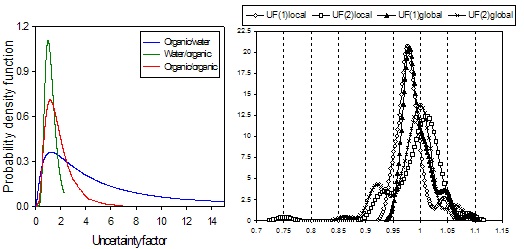
In chemical and biochemical systems, although process thermodynamics is well understood and experimental data is available, the mathematical models representing these systems may be subject to uncertainties. One example of this is UNIFAC (Hansen et al., 1991) model, which is a group contribution model, used to compute thermodynamic properties of materials, from the sum of contributions from each of the materials component parts. The uncertainties in UNIFAC model arise from the fact that, experimental data used for fitting the interaction parameters between UNIFAC groups is only available at a limited concentration range (5-95%) and mostly for compounds of similar size. Also highly nonlinear correlations exist between these interaction parameters. In Figure 2A the uncertainties in activity coefficients at infinite dilution computed by UNIFAC method are shown to predict the solvent selection objectives for the acetic acid-water separations, in a study by Kim and Diwekar (2002). The deviation of uncertainty factors from the value of one, which corresponds to excellent agreement with experimental data, shows the degree of uncertainty in this model.
Nonlinear parameter estimation is also a source of uncertainty in thermodynamic models, where a set of experimental data is represented by a correlative model and the model parameters are estimated based on a least squares or maximum likelihood analysis. In most of the cases, the objective function in nonlinear parameter estimation problems is non-convex and may have multiple local optima. It was shown that for some data sets published in DECHEMA vapor-liquid equilibrium (VLE) data collection (Gmehling and Onken, 1977-1990), the parameters predicted for an activity coefficient model such as
Another aspect of this work is to look at biological systems and use the insight gained from modeling uncertainties in chemical systems to address the complexities and natural variability observed in biological systems. These systems are more complex with many interactions between the system variables and some of the model parameters are not easily measurable. For instance, in optimal drug delivery, simplified models are often used to represent the interactions between the delivered drug and patient parameters that need to be controlled or improved. These models do not take into account the variations of some patient parameters with respect to time or the external effects of the patient's lifestyle.
The aim of this proposed work is to develop a systematic way to model and characterize these uncertainties in chemical and biological systems. These uncertainties can be classified into two groups: static uncertainties and dynamic uncertainties. Examples of static uncertainties are uncertainties observed in initial variables, input conditions or model parameters. The static uncertainties, such as uncertainties in thermodynamic model parameters affect the process model parameters changing with time especially for dynamic processes. Therefore, the static uncertainties are translated into time-dependent uncertainties.
In this work, while static uncertainties are characterized using probability distribution functions and propagated into the models, the dynamic uncertainties are represented by using stochastic differential equations, namely Ito processes which originate from real options theory in finance (Dixit and Pindyck, 1994). These uncertainties will be incorporated into process simulations and optimal control.
In general control refers to a closed loop system, where the desired operating point is compared with an actual operating point and knowledge of the difference is fed back to the system. On the other hand, optimal control problems are defined in their time domain, and their solution requires establishing an index of performance for the system and designing the course (future) of action so as to optimize a performance index. Therefore optimal control allows us to make future decisions. The options theory provides a generalized tool to characterize, quantify and propagate time-dependent uncertainties. Combined with optimal control methodology, it presents an efficient framework to obtain optimal decisions in the face of time-dependent uncertainties. The proposed work aims to apply this technique to case studies in batch processing and optimal drug/hormone delivery to improve performance objectives and achieve optimal operating policies.
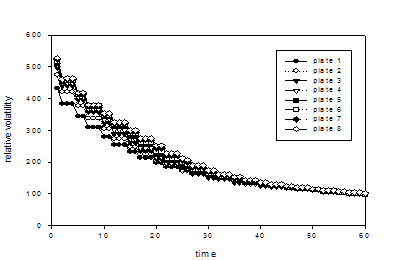 |
Figure 1: Rigorous simulation results for the separation of methanol from bio-diesel (Ulas and Diwekar, 2004)
 |
(A) (B)
Figure 2: (A) Uncertainties in predicted by UNIFAC (Kim and Diwekar, 2002); (B) Probability density estimate of uncertainty factors for six experimental data sets of tert-butanol(1)-n-butanol(2) system for globally optimal energy parameters predicted using IN/GB method for Wilson model and locally optimal energy parameter values published in DECHEMA VLE Data Collection. (Ulas et al., 2005)
References
Dixit, A.K., and Pindyck, R.S.: Investment under Uncertainty,
Gau, C.Y., Brennecke, J.F., and Stadtherr, M.A.: Reliable nonlinear parameter estimation in VLE modeling, Fluid Phase Equilibria, 168(1): 1-18, 2000.
Gmehling J. and Onken U. (1977-1990), Vapor-Liquid Equilibrium Data Collection, Frankfurt/Main: DECHEMA,
Hansen, H., Rasmussen, P., Fredenslund, A., Schiller, M. & Gmehling, J.: Vapor-liquid equilibria by UNIFAC group contribution: 5. revision and extension. Industrial and Engineering Chemistry Research, 30:2352, 1991.
Kim K-J and Diwekar UM, ‘Hammersley stochastic annealing: efficiency improvement for combinatorial optimization under uncertainty' IIE Transactions 34 (9): 761-777, 2002.
Korovessi, E., and Linninger, A.: Batch Processes, CRC Press,
Ulas, S., and Diwekar, U.M.: Thermodynamic uncertainties in batch processing and optimal control, Computers and Chemical Engineering, 28(11): 2245-2258, 2004.
Ulas, S., Diwekar, U.M., and Stadtherr, M.A.: Uncertainties in parameter estimation and optimal control in batch distillation, Computers and Chemical Engineering, 29(8): 1805-1814, 2005.
See more of Computing and Systems Technology Division
See more of The 2007 Annual Meeting