Wednesday, November 7, 2007 - 9:45 AM
376d
CO2 Interaction with Char Nitrogen in Oxy-Coal Combustion Systems
Different strategies have been proposed to reduce greenhouse gas emissions caused by energy production: improving efficiency in the use of energy, using renovable energy sources (specially biomass [5-7]) reducing the consumption of fossil fuels, etc. However, the constant growth of global population and higher industrial development causes an increase in energetic demand, making difficult diminishing the reduction of CO2 emissions. Therefore, it is necessary to implement ways to sequester CO2. Currently the principal alternatives suggested for CO2 sequestration are: pre-combustion capture, post-combustion capture; and oxy-fuel combustion [1, 8]
Oxy-coal combustion. Conventional combustion processes produce flue gases with relatively low concentration of CO2 causing high costs in the separation and sequestration of this gas. One option to facilitate the process is to increase its concentration in the flue gas by partially eliminating the nitrogen of the air used [9]. In oxy-coal combustion, oxygen enriched gas (instead air) is used leading to the formation of high concentrations of CO2 and H2O [8, 9]. Oxy-coal combustion has the following advantages: a) recuperation of CO2 is easier; b) higher efficiency due to high concentration of oxygen; c) diminishing NOx emissions due to elimination of air N2 [3]. The principal problem related to oxy-coal combustion is the control of the very high flame temperatures and heat transfer caused by the high oxygen concentration. To reduce the temperature, part of the flue gas, rich in CO2, can be recirculated to the combustor [8] modifying the furnace heat transfer due to changes in gas properties. At the same time, other pollutants as NOx and SOx are also recirculated in the processes [9].
Numerical studies have shown that recirculated CO2 not only reduces flame temperature. It has a chemical effect which is reflected by increasing the CO formation that modifies the oxidative routes, specially the formation and reduction of NO [8]. Croiset and Thambimuthu [9] studied the effect of CO2 with O2/CO2 mixtures and recirculated flue gas compared with the conventional air combustion. The regular process produces the highest NOx emission due to thermal NOx. Recirculation of flue gas diminishes NOx emission rate in about 40 %, probably due to reduction of NO to N2 when the flue gas is recirculated to the combustor [9]. In addition, it has been observed that combustion in O2/CO2 mixtures reduce the NOx emission rate (from fuel-N) confirming the chemical effect of CO2 in the NOx formation mechanism. One possibility is that CO2 reacts with the char producing CO which promotes the reduction of NO in gas phase [3]. However, the CO2 effects on the heterogeneous reactions that may lead to NO reduction have not yet been investigated.
Computational methodology
Char was modeled by a single graphene layer with edge unsatured carbon atoms to represent the active sites, while the other carbon atoms were terminated with hydrogen to reduce truncation effects. Highly oxidized chars are used to simulate the conditions in the real process. All calculations are performed at B3LYP level of theory using the 6-31G(d) basis set in the Gaussian 03 package.
Results and discussion
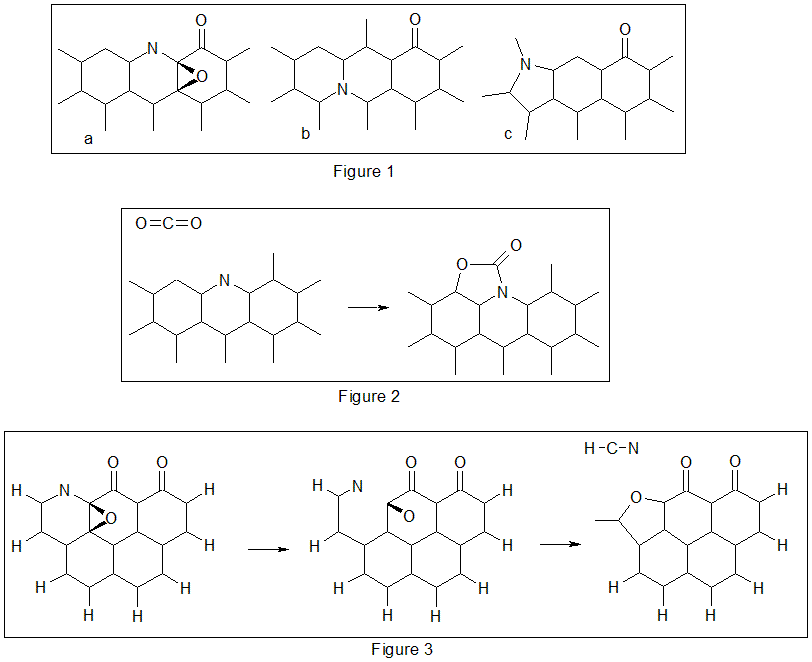
The study is focused in the interactions between different nitrogen surface complexes with recycled gases. Figure 1 shows the char models in the zig-zag configuration for different complexes: pyridinic, quaternary and pyrrolic nitrogen in oxidized surfaces with some active sites where it is possible to have O2, CO2 or NOx chemisorption.
Figure 1. Nitrogen complexes in oxidized chars: a) pyridinic; b) quaternary; c) pyrrolic nitrogen complexes.
Surface N-char interaction with CO2
Several studies have been carried out focusing in the CO2 chemisorption on carbon active sites [10]. CO2 can react with nitrogen complexes formed in the edge of graphene layers as shown in Figure 2. In this case, we illustrate the formation of a complex involving both a carbon active site located near a pyridinic nitrogen atom. This complex may undergo thermal decomposition to different products.
Figure 2. CO2 chemisorption forming a surface complex.
Formation of NOx precursors
In coal combustion NOx is primarily formed by oxidation of HCN and NH3 in gas phase, these gases are known as NOx precursors, and they are formed by nitrogen complexes decomposition during the process [11]. One possible route for HCN desorption in a highly oxidized surface can be explained by the reaction shown in Figure 3. This evolution is facilitated by the presence of epoxy groups [12] promoting the HCN formation from a pyridinic nitrogen complexes. Details of the reaction will be explained later.
Figure 3. Possible route for HCN evolution and formation of cyclic ether under oxy-combustion environment.
This study shows preliminary results of the energetics of some of the interactions between C-char and N-char with recirculated gases.
REFERENCES
1. Davison J., Energy, 2007. In press. 2. Beér J.M., Progress in Energy and Combustion Science, 2000. 26: p. 301-327. 3. Hu Y., et al., Fuel, 2000. 79: p. 1925-1932. 4. Atkinson R., Atmospheric Environment, 2000. 34: p. 2063-2101. 5. Nussbaumer T., Energy & Fuels, 2003. 17: p. 1510-1521. 6. Bain R.L., Overend R.P., and Craig K.R., Fuel Processing Technology, 1998. 54: p. 1-16. 7. Adams B.R. and Harding N.S., Fuel Processing Technology, 1998. 54: p. 249-263. 8. Park J., et al., Energy & Fuels, 2007. 21: p. 121-129. 9. Croiset E. and Thambimuthu K.V., Fuel, 2001. 80: p. 2117-2121. 10. Radovic L.R., Carbon, 2005. 43: p. 907-915. 11. Tian F.-J., et al., Fuel, 2005. 84: p. 2102-2108. 12. Sánchez A. and Mondragón F., Journal of the Physical Chemistry C, 2007. 111: p. 612-617.
See more of Topical 2: New Frontiers in Energy Research
See more of The 2007 Annual Meeting