Thursday, November 8, 2007 - 4:20 PM
637c
Bioseparations Using A Nanoisland Array Made Of Self-Assembled Metal Oxides
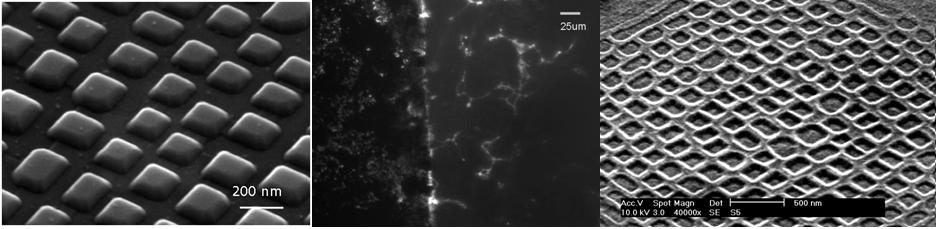
Our novel metal-oxide based nanostructures present a tunable, low-cost, robust platform for nanofluidic devices. We created an orthogonal network of nanochannels (50-200nm) and drove DNA through them via electrophoresis and capillary action. These dimensions distributed uniformly across large areas (25 mm2 currently, larger expected) are optimal for examining DNA, proteins, or other nanoparticles. We imaged individual molecules of DNA within the channels and demonstrate separation of DNA by size. We also characterized the surface of the nanoislands, made of a mixture of GDC (gadolinium doped ceria) and YSZ (yttria-stabilized zirconia), and developed means for modifying the naturally hydrophilic surface via UV-initiated polymer grafting. The nanoislands can be selectively treated based on surface chemistry and photolithography. Finally, we demonstrate pattern transfer to polymers to enable inexpensive polymeric nanofluidic devices. The nanoislands and substrate are much stronger than silicon wafers, making a superior mold material.
See more of #637 - Nanostructured Biomimetic and Biohybrid Materials and Devices (T8005)
See more of Topical 8: Bionanotechnology
See more of The 2007 Annual Meeting
See more of Topical 8: Bionanotechnology
See more of The 2007 Annual Meeting