Monday, November 5, 2007 - 5:10 PM
118f
Synthesis And Characterization Of A New Class Of Biomaterials: Antioxidant Polymers
In this work we present a new class of degradable polymers and polymeric oligomers with antioxidant activity, which are hypothesized to attenuate this oxidative mechanism by providing a slow antioxidant release. Further, antioxidant polymeric materials may provide robustness to current vascular oxidative stress therapies, which seek to deliver antioxidant enzymes for the treatment of diseases such as ischemia reperfusion and acute lung injury (Dziubla et. al., 2005).
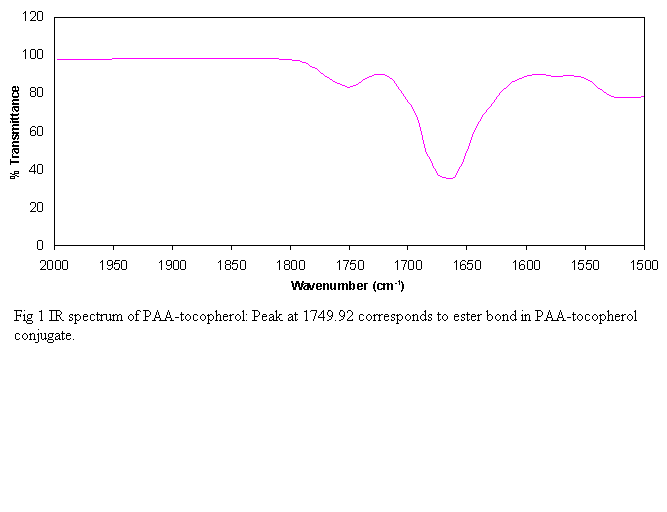
We conjugated tocopherol (Vitamin E), lipophilic free radical scavenger that has been shown to protect tissues from mild forms of oxidative stress (Misso and Thompson, 2005), to poly(acrylic acid) to create a biodegradable antioxidant polymer with inherent therapeutic value. Steglich Esterification (Neises and Steglich, 1978) chemistry was used to conjugate tocopherol to poly(acryclic acid). FTIR and 1H-NMR spectroscopy techniques along with molecular weight measurement by Gel Permeation Chromatography were used to characterize synthesized antioxidant polymer. Antioxidant activity and degradation kinetics of antioxidant polymer were studied using an in-vitro assay.
References:
B. Neises and W. Steglich, Simple method for the esterification of carboxylic acids, Angew. Chem. Int. Ed. 17 (1978) 522-524
N.L. Misso and P.J. Thompson, Oxidative stress and antioxidant deficiencies in asthma: potential modification by diet, Redox Rep 10 (2005) 247-255
P. Kirkham, Oxidative stress and macrophage function: a failure to resolve the inflammatory response, Biochem Soc Trans. 35(Pt. 2) (2007) 284-287
T. Dziubla, A. Karim, V. Muzykantov, Polymer nanocarriers protecting active enzyme cargo against proteolysis, J. Control. Release 102 (2005) 427-439
W. Jiang, S. SU, R. Eberhart and L. Tang, Phagocyte responses to degradable polymers, Journal of Biomedical Materials Research Part A, In Press
See more of Materials Engineering and Sciences Division
See more of The 2007 Annual Meeting