Tuesday, November 6, 2007 - 5:18 PM
323g
Influence Of Magnetic Field On Local Flow And Turbulence In 300mm Cz-Si Crystal Growth Process
For this purpose, we use two dimensional as well as three dimensional CFD based models to simulate the Silicon melt flow which is subjected to rotational speed and magnetic field. In these models, we consider natural convection due to temperature difference, forced convection due to crystal/crucible rotation, and the Lorentz force due externally applied magnetic filed. Turbulence in the system is modeled using low Reynolds number k-e model. The marangoni stresses generated due to thermocapillarity are considered at gas-melt interface. Resultant model equations, i.e., the conservation of mass, energy, and momentum along with phase change are solved using CFD code FLUENT 6.3. The temperature profile along the boundaries of the crucible and crystal were implemented from the global simulation in which convection and radiation heat loss from crystal and crucible were taken into account.
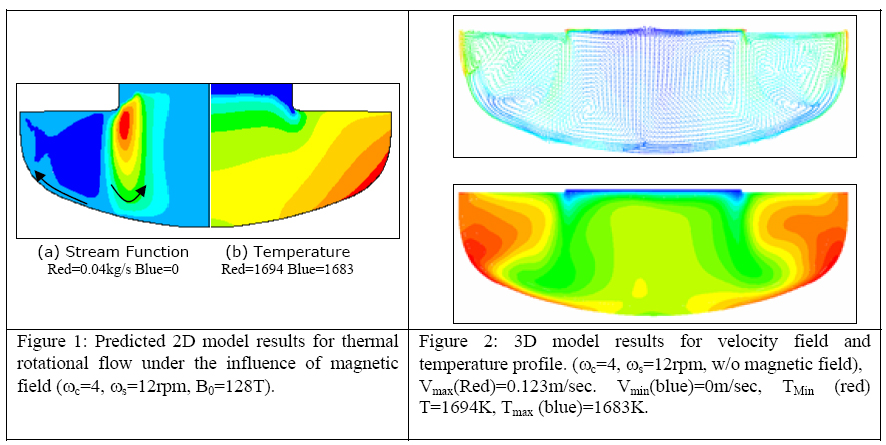
A numerical parameter study is performed to investigate the effect of applied magnetic field on local flow and turbulence parameters. Simulation results indicate that strong vertically upward flow dominates near crystallization zone (Fig. 1a) which increases temperature gradient in the same region (Fig.1b). 3D model results show completely non-symmetric temperature as well as flow profiles in the melt region (Fig. 2). Model results presented here are found to be useful for optimization of operational parameters for producing better quality crystals.
References:
1) Kumar V., Basu B., S. Enger, G. Brenner and F. Durst, Jou. of Crystal Growth, 255, 27 (2003).
2) Kalaev, V.V., D. P. Lukanin, V. A. Zabelin, Yu. N. Makarov, J. Virbulis, E. Dornberger, W. von Ammon, Jou. Crystal Growth, 250, 203 (2003).
3) Th. Wetzel, J. Virbulis, A. Muiznieks, W. von Ammon, E. Tomzig, G. Raming, M. Weber.. Jou. of Crystal Growth, 266, 34 (2004).
See more of Materials Engineering and Sciences Division
See more of The 2007 Annual Meeting