Wednesday, November 7, 2007
510ai
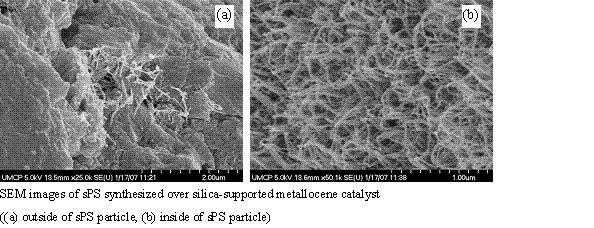
Crystallization And Network Formation Of Syndiotactic Polystyrene Synthesized With Metallocene Catalysts
References
[1] Lee, H. W.; Chung, J. S.; Choi, K. Y. Physical transitions and nascent morphology of syndiotactic polystyrene in slurry polymerization with embedded Cp*Ti(OMe)3/methyl aluminoxane catalyst, Polymer, 2005, 46, 5032-9.
[2] Malik, S.; Rochas, C.; Deme, B.; Guenet, J. M. Thermoreversible gelation of syndiotactic polystyrene in naphthalene, Macromolecular Symposia, 2005, 222, 73-9.
[3] Itagaki, H.; Mochizuki, J. Size and distribution of free volume in thermoreversible gels of syndiotactic polystyrene, Macromolecules, 2005, 38, 9625-30.
[4] Daniel, C.; Avallone, A.; Guerra, G. Syndiotactic polystyrene physical gels: Guest influence on structural order in molecular complex domains and gel transparency, Macromolecules, 2006, 39, 7578-82.
[5] Guenet, J. M. Microfibrillar networks: Polymer thermoreversible gels vs organogels, Macromolecular Symposia, 2006, 241, 45-50.
See more of Materials Engineering and Sciences Division
See more of The 2007 Annual Meeting