Thursday, November 8, 2007 - 4:30 PM
646d
Solvent Effects In The Hydrogenolysis Pathways Of Propionic Acid
The catalytic hydrogenation of a wide range of fine chemical and pharmaceutical oxygenate intermediates as well as biorenewable platform chemical intermediates are carried out in solvents over supported metal particles1,2. The metal as well as the solvent can cooperatively influence the kinetics and the governing reaction pathways. There have been very few efforts, however, focused on understanding the fundamental molecular transformations that occur between the metal and solvent and their influence on catalysis. The unique combination of the solvent and metal may offer the ability to tune the rate, selectivity and catalytic performance. Towards this end, we have carried out ab initio Density Functional Theoretical (DFT) calculations to explore different mechanisms in the hydrogenolysis of propionic acid to propanol over Ru(0001) in vapor as well as aqueous phase. Effectiveness of transition-metal-based bimetallic catalysts (Ru-Re) will also be considered here.
We first examined the vapor phase hydrogenation of propionic acid on Ru(0001). In order to determine the energetically most favorable path for the overall hydrogenolysis reaction, a series of elementary paths have been probed. Figure 1 illustrates the complete network of steps that lead to hydrogenated product i.e propanol. Binding energies of all the surface intermediates, in their most stable form of adsorption, were calculated. These energies were in conformity with other DFT studies on acetic acid hydrogenolysis3. Surface reaction energies were computed from binding energies of the intermediates as shown in figure1. Based on reaction energies, the reaction pathway involving the formation of the acetyl intermediate was found to be most favorable. The acetyl surface intermediate reacts with surface bound hydrogen to form propanldehyde which in turn reacts with surface hydrogen in succession via the Horiuta-Polanyi mechanism to form propanol. Activation barriers for each of these steps have been computed as shown in figure 2.
Next, we examine the effect of a solvent (water) on the reaction kinetics and energetics. We have observed that the presence of water can not only lower the activation barriers for the elementary steps by stabilizing the transition state intermediates, but also provide alternate pathways4. The structural arrangement of water molecules on Ru(0001) is similar to the bi-layer model suggested by Doering and Madey5. The adsorption of Propionic acid and other intermediates in solution is thought to proceed in a similar manner but requires the desorption or displacement of at least one water molecule on the surface. As in vapor phase reaction, we will look into the most favorable pathway in solvent pahse reaction and compare the energetics and kinetics. .
DuPont studies have shown the usefulness of bimetallic catalysts such as Pd-Re and Ru-Re in hydrogenation of maleic acid to tetrahydrofuran6. In the alloyed system, the binding energies of the intermediates are lowered due to shift in d-band center away from the Fermi level. Hence, we expect a lower activation barrier for the elementary paths in hydrogenolysis of propionic acid on Ru/Re(0001).
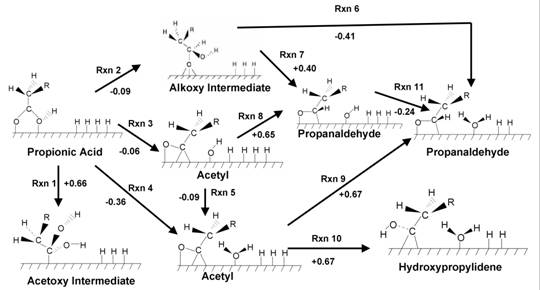
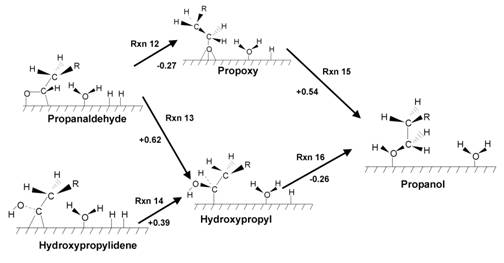
Fig. 1. Various reaction pathways for the hydrogenolysis of propionic acid to propanol on Ru(0001). All energies are in eV.
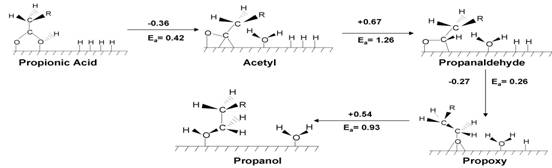
Fig. 2. Most plausible pathway for the hydrogenolysis of propionic acid to propanol on Ru(0001). All energies are in eV.
References
1. Beccat, P.; Bertolini, J.C.; Gauthier, Y.; Massardier, J.; Ruiz,
P. J. Catal. 126, 451, (1990).
2. 3. Pallassana, V., Neurock, M. J. Catal. 209, 289 (2002) 4. Desai, S.K., Pallassana, V., Neurock, M. J. Phys. Chem. B. 105, 9171 (2001). 5. Doering, D.; Madey, T.E. Surf. Sci. , 123, 305 (1982). 6. Mabry, M., and Company,
See more of Catalysis and Reaction Engineering Division
See more of The 2007 Annual Meeting