Tuesday, November 6, 2007 - 5:30 PM
295g
An along-the-Channel Model for Carbon Corrosion Due to Local Fuel Starvation of Pemfcs
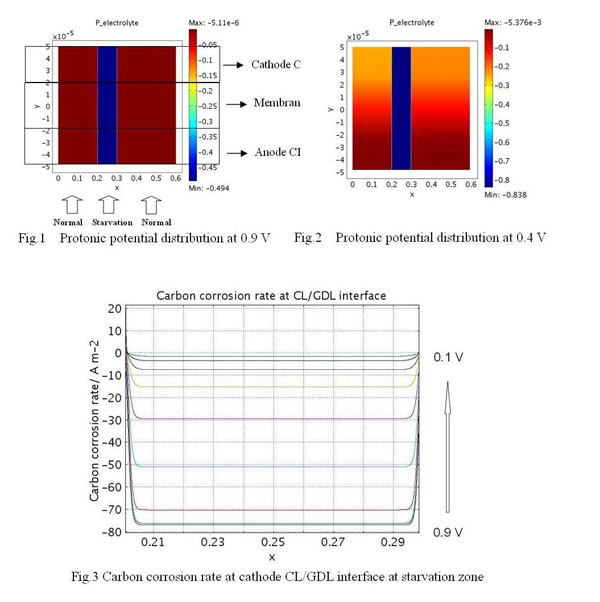
Proton exchange membrane fuel cells (PEMFCs) have become a promising alternative energy source in the past decade. Currently there are a few factors that delay the commercialization of PEMFCs, e.g. cost of materials, hydrogen infrastructure, and fuel cell durability etc. The issue of degradation of the membrane electrode assembly (MEA) materials is a major obstacle to wide adoption of fuel cells. In the literature, several degradation modes have been identified for PEMFCs: (1) membrane degradation (2) dissolution and migration of Pt particles (3) contamination of MEA due to poisoning, and (4) corrosion of carbon support in the catalyst layer due to local fuel starvation. Much attention thus far has been focused on the first three modes and less has on the issue of carbon corrosion. For the topic of carbon corrosion, experimental investigation has been reported by [1]. Modelling work have been reported by [2][3], although these models are limited to zero-dimension (0-D) or one-dimension (1-D) and the electrochemistry considered is not coupled with other transport processes, e.g. oxygen through the membrane and transport of proton in the catalyst layer, which may play an important role in determining the carbon corrosion rate. In the present study, we report on the development of a 2-D along-the-channel model for investigation on carbon corrosion due to local fuel starvation. In this mode, transport of the reactant gases, water in different phases, proton and electron are solved in a coupled manner. Carbon corrosion kinetics is introduced into the model to predict the corrosion rate at the cathodic catalyst layer of the starvation zone. An abrupt decrease of protonic potential along the interface of normal and starvation zone is captured. The carbon corrosion rate at local zone can be predicted by the model. A series of parametric study is carried out based on the ATC model. The following parameters are found to have significant impact on the carbon corrosion rate: starvation zone operational potential, protonic conductivity of the catalyst layer, starvation area ratio, carbon corrosion kinetics and oxygen permeability through the membrane. It is found that under the conditions of high operational potential, low protonic conductivity, large starvation area ratio, fast carbon corrosion kinetics and high oxygen permeability, rapid carbon corrosion rate can be expected. As an example, the average carbon corrosion rate at 0.9 V is estimated to be 78 A m-2 versus that of 8 A m-2 at 0.3 V. Figures 1 and 2 show the predicted protonic potential at 0.9V and 0.4 V, respectively. Figure 3 shows predicted carbon corrosion rate at cathode catalyst layer/gas diffusion layer interface at the starvation zone
[1] L. M. Roen, C. H. Paik, T. D. Jarvi, Electrocatalytic Corrosion of Carbon Support in PEMFC Cathodes, Electrochemical and Solid-State Letters, 7 (1) A19-A22 (2004) [2] C. A. Reiser, L. Bregoli, T. W. Patterson, J. S. Yi, et al, Electrochemical and Solid-State Letters, 8 (6) A273-A276 (2005). [3] J. P. Meyers, R. M. Darling, Journal of Electrochemical Society, 153 (8) A1432-A1442 (2006).
See more of #295 - Fuel Cell Durability (TC004)
See more of Topical C: Fuel Cells and Alternative Fuel Systems
See more of The 2007 Annual Meeting
See more of Topical C: Fuel Cells and Alternative Fuel Systems
See more of The 2007 Annual Meeting