
The description of the mass transfer of gaseous species in glassy polymers is of major interest for numerous
industrial applications (packaging, adhesives, controlled release, membrane processes..). A quantitative
description of penetrant solution diffusion in glassy polymers has been developed during 60s and 70s, known
as the Dual Mode Model. This theory decomposes the sorbed molecules into two species. The molecules
obeying Henry law are considered as mobile and the molecules following Langmuir law are considered as
immobile in a first approach. Later, this theory has been extended to consider the immobilization as
partial for molecules following Langmuir law order to obtain a closer approach to the experimental results.
The partial immobilization model achieves an acceptable time lag prediction (i.e. transient diffusion data)
by assuming a local equilibrium everywhere in the membrane. Thus the partial immobilization model is
considered nowadays as the most appreciate and relevant transport model for the gas diffusion in glassy
polymers.
A common feature of the total and partial immobilization models is to make use of the so-called local
equilibrium hypothesis. This assumption was initially applied in the total Immobilization Model as a neces-
sary and sufficient condition for its mathematical description. Although the Immobilization Model was later
shown not be able to quantitatively represent the transport data, the hypothesis has been maintained in
the Partial Immobilization Model. This assumption is of interest because it offers the possibility to largely
decrease the complexity of the mathematical framework: it enables indeed the ratio of the Langmuir and
Henry population to be calculated throughout the polymer matrix thickness, leading to one partial differ-
ential equation to be solved in place of two. Surprisingly, to our knowledge, no research has addressed the
analysis of the incidence of the local equilibrium hypothesis on the prediction performances of the Dual
Mode Model. This question has been addressed through a systematic simulation study and the main results
will be reported in this communication.
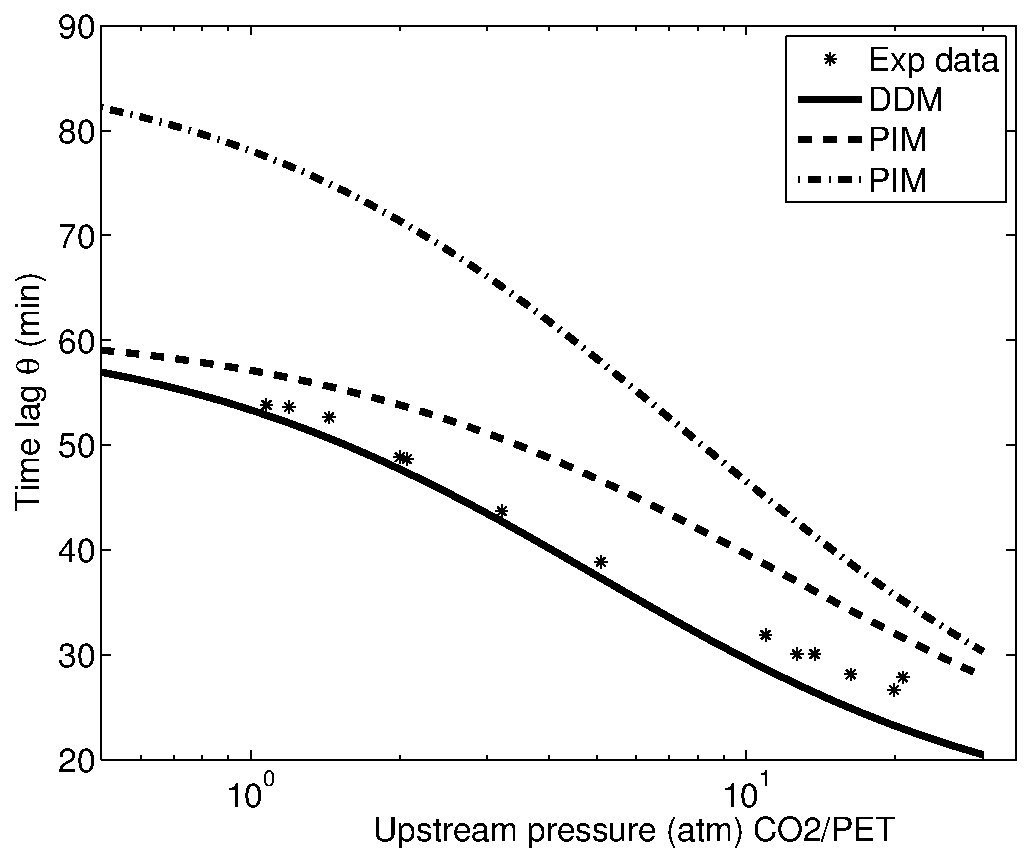
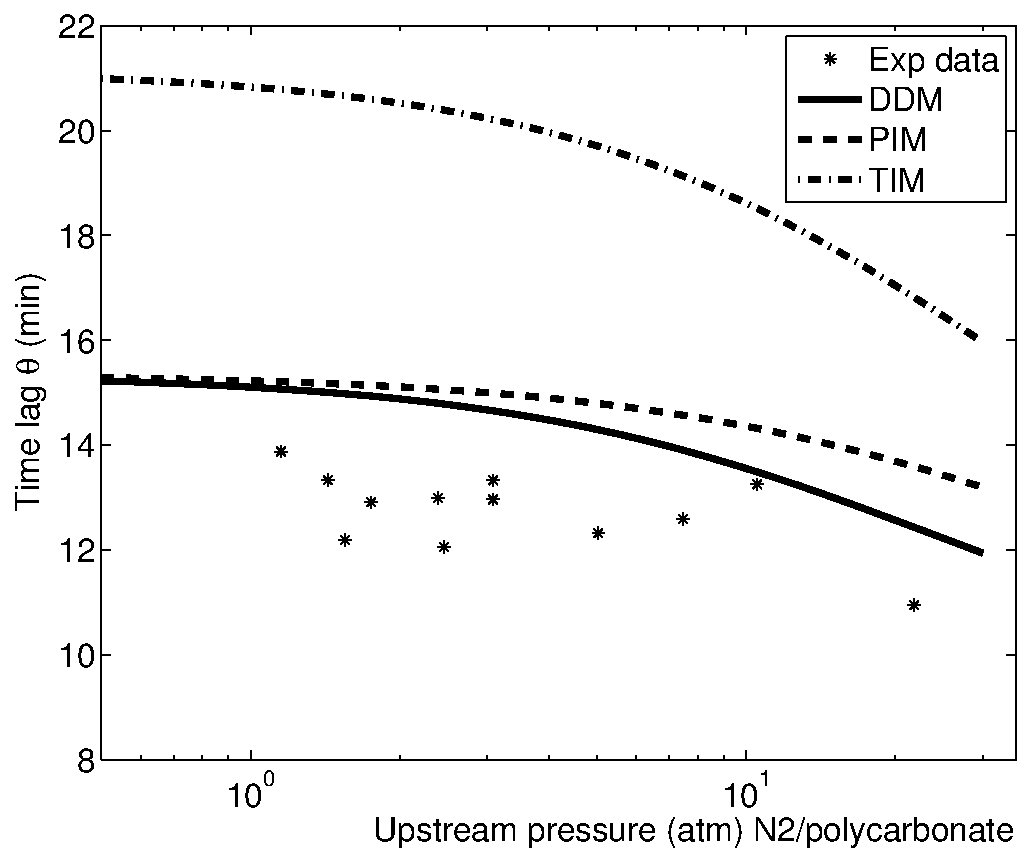
The experimental time-lag data previously reported for a series of ten different systems (one glassy
polymer / one gaseous penetrant) by different authors have been compared to the predictions of three
different models: the total immobilization model (TIM), the partial immobilization model (PIM) and the
dual mode model without the local equilibrium hypothesis (named hereafter the Dual Diffusion Model,
DDM). Remarkably, based on exactly the same set of dual mode parameters (sorption and diffusion data),
the latter one (DDM) offers the best global fit when compared to the two classical dual mode approaches.
Two examples of comparative curve fits are shown in figure 1, for the N2 /Polycarbonate and CO2 /PET
systems. It has to be stressed that the DDM model leads to the same permeability expression as the
partial immobilization model under steady state conditions. Additionally, the general framework of the dual
mode model is maintained for the DDM, except the need to make use of a local equilibrium relationship
within the polymer matrix. The predictions obtained by the three different approaches on the different set
of experimental data will be shown and discussed. The implications offered by the DDM, especially with
regard to the no more required local equilibrium assumption will be more specifically analyzed.
See more of this Group/Topical: Materials Engineering and Sciences Division