
Pinched flow fractionation (PFF) is a microfluidic process for the separation of particles by size that has been used, for example, to sort cells. In PFF, a particle-laden fluid stream enters a narrow channel, the pinched segment, together with a diluent stream that pushes the particles against one wall of the segment. The particles separate by size upon leaving the pinched segment into a much wider outlet channel. So far, modelling of this process has been based on the assumption that the particles follow the streamlines of the particle-free flow. Since some experimental observations cannot be explained with this assumption, fully resolved simulations of PFF are needed to model the process more accurately and to understand deviation from the idealization.
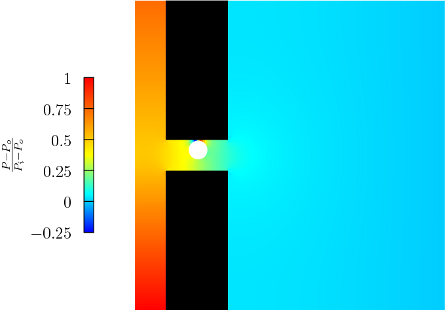
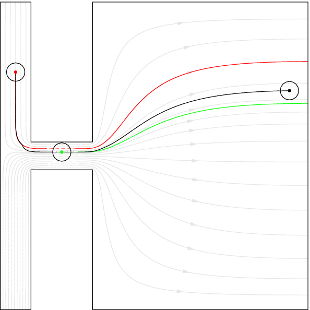
The lattice Boltzmann method (LBM) and immersed boundary method were used to simulate PFF. The methods were validated against analytical results and experimental data available in the literature. The PFF simulation results were compared with experimental PFF performance data in the literature. The effects of the diluent flow rate and the width of the pinched segment on separation performance and cross-streamline migration were analyzed. Lift forces experienced by the particles as they exit the pinched segment appear to play an important role in the observed migration and may explain some experimental results. The figures show a sample pressure field when the spherical particle is in the pinched segment and the trajectory of the particle (black) together with streamlines of the particle-free flow. The red streamline passes through the initial position of the particle; the green streamline passes through the position of the particle when it is in the middle of the pinched segment. The sphere deviates from the two streamlines significantly. A collision with the channel wall caused the deviation of the sphere from the red streamline at the inlet of the pinch; lift forces caused the deviation from the green streamline at the outlet.
Fully resolved three dimensional simulations of PFF allow improved design of these devices, particularly for complex situations, such as the separation of non-spherical particles or dense suspensions. Simulations can also provide the insight required to improve the accuracy of simpler models.
See more of this Group/Topical: Engineering Sciences and Fundamentals