
Analysis of AFM results with MD calculations on single-molecule stretching of poly(ethylene oxide) in water and hexane
Mangesh I. Chaudhari and Lawrence R. Pratt
Department of Chemical and Biomolecular Engineering
Tulane University, New Orleans, LA, 70118, USA.
ABSTRACT :
Elasticity of a single polymer in solution is important for the modeling of foams/gels and can be directly measurable by atomic force microscopy (AFM). The work compares stretching behavior of poly (ethylene oxide) polymer in water and hexane. Parallel tempering molecular dynamic simulations on aqueous 11-, 21-, and 31-mer poly (ethylene oxide) solutions differentiates low-, moderate-, and high- extension regions (FIG.1) and explains that water swells these polymers. The low extension (low force) behavior obtained from experimental and simulation data is often complex. Our previous results, which combined parallel tempering and window sampling, clarified the low-extension behavior. Here we return to examine the measured high extension behavior in detail. We compare simulation results for high polymer extensions with available experimental data, and we compare simulations for different solvents with one another. We analyze simulation results on aqueous solutions from the perspective of cooperative H-bonding of water molecules to the ether oxygens in order to clarify the role of solvent H-bond bridges in the conformational structures of these polymers.
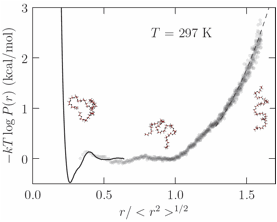 FIG. 1: Parallel tempering results for
T=297 K distinguish low-, moderate-, and high-extension regimes. The
low-extension regime includes the contact peak on the left of these graphs, and
is associated with the analogous contact-minimum in the CH4ÉCH4
potential-mean-force (pmf). That pmf
has been studied in numerous previous simulation calculations over several
decades. The solid curve represents short-distance Ôhydrophobic bonds' with
window sampling that is consistent with the direct simulation results. X-axis
is normalized with RMS end-to-end distance and emphasizes that the high extension
region starts after this value. Parabola fit through high extensions is
comparable with experimental data available on stretching of these polymers.
See more of this Group/Topical: Materials Engineering and Sciences Division