
Pulse-Jet regenerated bag filters are increasingly becoming an integral part of process plants. The problems with their operation directly influence the process plant operation and may involve loss of production time. Therefore, a long term stable operation of the filter plant is desirable for the manufacturers as well as process operators. Intrinsically the bag filter operation is semi-continuous which consists of alternate periods of filtration (cake formation) and regeneration (cake detachment). The dust deposited during filtration period (filter cake) is a source of higher pressure drop which must be removed at certain operating points determined either by a preset upper pressure drop level or constant filtration time. The filter cake is removed by short duration high pressure reverse pulse-Jet during regeneration period. The regeneration period is normally very short as compared to filtration period for a stable filter operation. The plant may run unstable due to variation of the operating parameters. The instability may be temporary where the filter reaches a new stable steady state, reversible where system can be restored to its initial conditions by manipulating the operating parameters, or it may be irreversible so that the parameters like pressure drop keeps on increasing beyond the allowable limits of the plant. Then shutdown of the plant remains the only choice.
The pulse-jet bag filters can be operated (1) between upper and lower pressure drop limits with no control on number of pulses, or (2) at upper pressure drop limit with a fixed number of pulses without regulating the lower limit, or (3) for fixed filtration time and fixed number of pulses. The stability is measured by (a) stable and steady filtration cycle time and number of cleaning pulses per filtration cycle, (b) by the steady filtration cycle time and a steady lower pressure drop limit, or (c) steady upper and lower pressure drop limits respectively depending on the bag cleaning sequence (1), (2) or (3).
While the stable operation is desirable, it is observed that the filter de-rails under many operating situations. Knowledge of the operating conditions which have potential for instability is important. Few attempts are reported in literature for the prediction of stable versus unstable filter operation [1- 4]. Experimental investigation of the filter stability while operated in mode (1) is presented elsewhere [5]. Study of pulse-jet bag filter over a range of operating parameters which may or may not lead to unstable filter operation for the cleaning mode (2) is presented in this work.
The test facility consists of three rows of bags. The set up is presented elsewhere [6] while the operating conditions are listed in Table 1.
Table SEQ Table \* ARABIC 1: The range of operating parameters
Dust loading, c | Superficial velicity, u | Upper pressure drop limit, DPmax | Pules-jet pressure, Pjet | Pulses per row of bags |
[g/m3] | [mm/s] | [Pa] | [bar] | [ - ] |
3-5 | 27-68 | 800-2200 | 1.8-4 | 1 |
The difference between the static pressure developed by the pulse-jet and DPmax is the detachment over pressure (force intensity) responsible for the cake detachment. Based on the experimental investigations, the filtration time per pulse, detachment over pressure and velocity are plotted in Fig. 1. The operation is observed unstable at detachment over pressure below a threshold. At higher detachment over pressure, the operation is stable, however, two interesting situations are observed: first at 41 mm/s, a stable operation (a) went unstable (a to a1) because of reducing pulse pressure from 4 bar to 3 bar at 2200 Pa DPmax . Reducing DPmax could not stabilize the operation (a1 to a2). Only increasing the pulse pressure from 3 to 4 bar stabilizes the operation (a) at the same velocity. The second at 68 mm/s and 2300 Pa DPmax , stable operation (b) turns unstable (b to b1) and
(b1 to b2) when DPmax is reduced. The cycle time per pulse is so less that there is little filter cake formed during a filtration cycle. Decreasing the upper pressure drop limit increases the detachment over pressure but decreases the cake area load further. The over pressure can not remove the cake when there is no significant cake on the filter bag, therefore, the operation leads to continuous pulses.
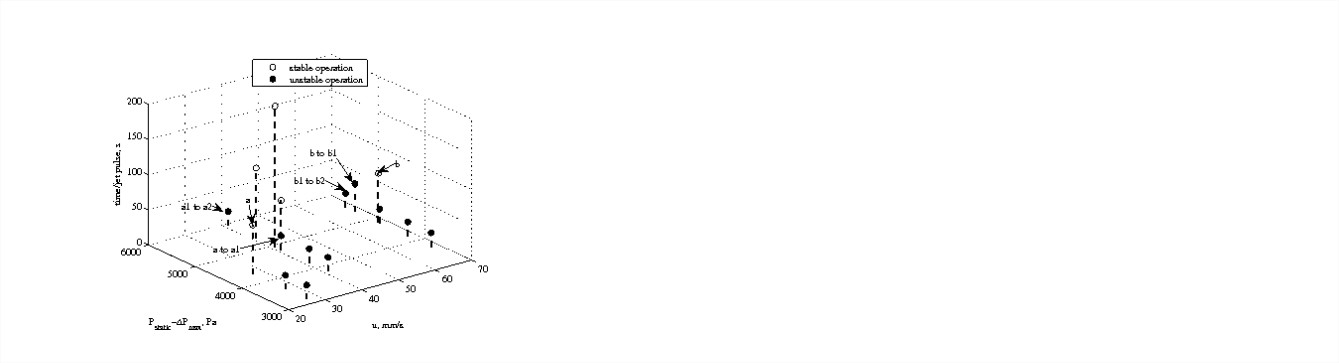
Figure SEQ Figure \* ARABIC 1: Effect of operating parameters on bag filter stability
This mode of regeneration control has less tolerance because regenerated area per cycle is fixed. If cake detachment becomes ineffective due to some reason, the lower pressure drop keeps on increasing and leads to either short filtration cycles or continuous pulses.
Many combinations are identified when the operation de-rails from stable to unstable operation on changing one of the operating parameters. Filtration velocity, jet pulse pressure and upper pressure drop limit have potential of de-railing stable operation to unstable. There exists a threshold detachment over pressure below which the operation leads to unstable condition at certain filtration velocity. This threshold increased with increasing velocity. Increasing cake detachment pressure by merely decreasing the upper pressure drop level will not work once the operation goes unstable. There is a certain lower limit on the upper pressure drop below which the operation runs unstable at specific velocity. The upper limit on the upper pressure drop level is expected above 2300 Pa however. Reducing upper pressure drop limit leads the system to unstable operation at higher velocity when filtration cycles are already short.
Thus conclusion can be made that the detachment of a thicker cake is more efficient as compared to a thinner cake at low cake area loads. There are set of conditions when operation becomes unstable irrespective of the path to reach those conditions. One can say that stable/unstable operation depends on prior set of conditions, therefore.
Acknowledgements
Authors acknowledge the project funding by Austrian Science Foundation (FWF) under project P 16313-No.7, financial support of Higher Education Commission, Islamabad, Pakistan, supply of needle felts by M/S Inspec Fibers (Lenzing, Austria), and M/S Alicona Imaging (Graz, Austria) for microscopic analysis of needle felts.
References
[1] Leith D. and Ellenbecker M. J. Theory for pressure drop in a pulse-jet cleaned fabric filter. Atmospheric Environment, 14(7):845–852, 1980.
[2] Morris K. and Millington C.A. Modeling fabric filters. Filtration and Separation, pages 478–483, November/December, 1983.
[3] Krammer G., Kavouras A., and Saleem M. Low frequency pressure drop patterns during continuous filter operation. In Proceedings of the International Congress of Particle Technology, PARTEC, 2004.
[4] Kavouras A. and Krammer G. A model analysis on the reasons for unstable operation of jet-pulsed filters. Powder Technology, 154:24–32, 2005.
[5] Saleem M., Krammer G., Ijaz A., Effect of operating parameters on stability of pulse jet bag filter: an experimental study, World Filtration Congress, 14-18 April, 2008, Leipzig, Germany.
[6] Saleem M., Krammer G., R¨uther M., and Bischof H. Optical measurement of cake thickness distribution and cake detachment on patchily cleaned commercial bag filters. In Proceedings of the International Conference and Exhibition for Filtration and separation Technology, volume II, pages 51–58, Wiesbaden, Germany, October, 2005.
See more of this Group/Topical: Separations Division