
Material
and Methods: Fibrin-based
engineered leaflets were cast with 4mg/ml fibrin gel and 1 million/ml neonatal
human dermal fibroblast (nhDF). For decellularization, leaflets were incubated in 1% SDS
over-night followed by 30 min rinse in 1% triton-X. Leaflets were characterized
for mechanical and biochemical properties. For recellularization,
leaflets were seeded with ahMSC. Reseeded samples
were evaluated for cell proliferation and invasion up to 3 weeks. Result
and Discussion: Engineered
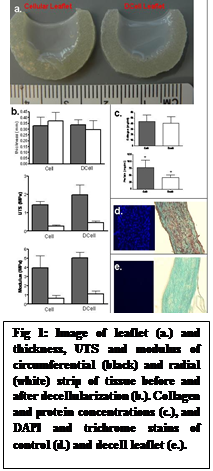
leaflets had thickness, mechanical properties (UTS and Modulus), and anisotropy
similar to native sheep pulmonary valve leaflets (the standard large animal
model). No change in mechanical properties was seen after decellularization
(Fig.1). Decellularization removed 99% of DNA with a drop in total protein
(indicative of cellular protein loss) but no change in collagen concentration. Recellularized leaflets showed MSC proliferation over time
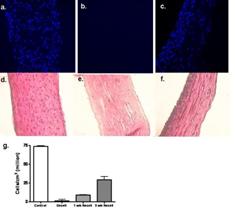
with gradual invasion of MSC into the leaflet tissue (Fig.2). The mechanical properties
after 3 weeks incubation with MSC showed no detrimental effects of MSC seeding
and subsequent culture, and there was no evidence of tissue contraction (no
change in thickness). MSC maintained positive staining for CD29, CD44, and
CD90, and negative staining for CD45 and CD34 after 3 weeks.
 Introduction: Tissue engineered heart valves
(TEHV) can revolutionize valve replacements, especially for juvenile patients.
While much progress has been made toward implanting TEHV, a major limitation to
date has been retraction of the leaflets by the cells transplanted with the
TEHV, especially those developed from fibrin (Syedain et al. 2011, Flanagan et
al. 2009). Here, we present a novel approach of decellularizing
an engineered leaflet made from fibrin that is remodeled by dermal fibroblast,
and subsequently recellularized with adult human mesenchymal stem cells (ahMSC).
The approach has potential to deliver off-the-shelf engineered leaflet that can
be recellularized with autologous stem cells.
 Conclusion:
We present here
an approach to remove the tissue-forming but also tissue-contracting
fibroblasts from TEHV, thereby creating a readily available biological scaffold
for reseeding with autologous stem cells. Preliminary work with recellularization shows good penetration and increased cell
density over 3 week without loss in tensile properties of the de/recellularized leaflets.

See more of this Group/Topical: Food, Pharmaceutical & Bioengineering Division