
Study of Gas Permeabilities in Styrene Ethyleneoxide (SEO) Block Copolymers
Matteo Minelli1, Marco Giacinti Baschetti1, Daniel T. Hallinan Jr.2, Nitash P. Balsara2
1 Dipartimento di Ingegneria Chimica, Mineraria e delle Tecnologie Ambientali (DICMA) Alma Mater Studiorum - Università di Bologna, via Terracini 28, 40131, Bologna, Italy.
2 Materials Sciences Division and Environmental Energy Technologies Division, Lawrence Berkeley National Laboratory, University of California, Berkeley, CA 94720, United States
Abstract
Transport properties of different gases such as oxygen, nitrogen, methane and carbon dioxide are characterized for a styrene-ethyleneoxide (SEO) triblock copolymer membrane at different temperatures ranging from 20 to 80°C.
The material consists of a PEO fraction of about 50% by weight and a crystalline part of about 10% at room temperature. DSC analysis allowed the evaluation of melting point at about 40°C whereas a lamellar structure with a domain spacing of 95 nm was observed through SAXS analyses.
Permeation experiments were carried out by means of a manometric [1] device and were performed in a range of temperature covering the melting region of PEO segment [2] allowing for the study of the effect of crystallinity on the mass transport behaviour. This material, indeed, is suitable for different applications such as membrane for gas separation as well as solid electrolyte in polymeric batteries [3, 4a&b].
The results of CO2 permeability, reported in Figure 1, showed a remarkable increases of both permeability and diffusivity (calculated through time lag method) when temperature is raised, and the behaviour deviates significantly from the Arrhenius law in the temperature range in which PEO melting takes place. Interestingly, data show very similar activation energies both at high and low temperature, but the calculated values are lower than those calculated by other authors [4-6], and reported in the literature, for amorphous PEO, which is expected to be the phase involved in the permeation phenomenon.
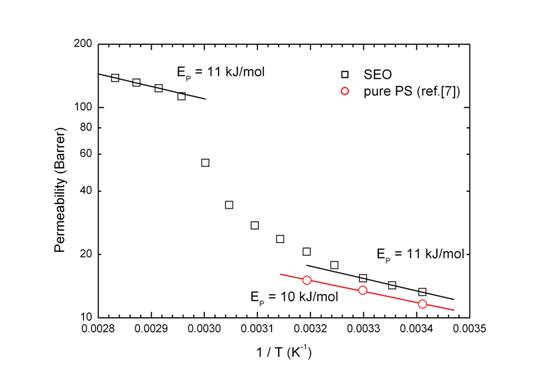
Figure 1, CO2 Permeability in SEO block copolymer at different temperatures.
The permeability data were analyzed by considering the block copolymer as a multiphase system in which the two moieties are endowed with different permeabilities. In this concern, the results show that at low temperature, the gas diffusion is mainly located in the PS [7] phase due to crystallinity of the PEO. On the contrary, at temperature above 50-60°C, the PEO (melt) is remarkably more permeable than the styrenic part and the observed P for SEO copolymer is one order of magnitude higher than the value at room temperature.
The same behaviour of permeability with respect to temperature above described for CO2 was also observed for the case of the other gases (O2, N2 and CH4); the steep increase of P occurs at the same temperature (between 40 and 60°C) and the trends at high and low temperature are once again comparable (similar activation energies) confirming the prevalent role of crystallinity change in the materials behaviour.
References:
[1] M. Minelli, M.G. De Angelis, F. Doghieri, M. Marini, M. Toselli, F. Pilati, Oxygen permeability of novel organic–inorganic coatings: I. Effects of organic–inorganic ratio and molecular weight of the organic component, Eur. Polym. Jou. l44 (2008) 2581–2588.
[2] H. Lin, B.D. Freeman, Gas solubility, diffusivity and permeability in poly(ethylene oxide), J. Membr. Sci. 239 (2004) 105–117.
[3] H. Lin, B.D. Freeman, Materials selection guidelines for membranes that remove CO2 from gas mixtures, J. Mol. Struct. 739 (2005) 57–74.
[4] a) Panday, A.; Mullin, S.; Gomez, E. D.; Wanakule, N.; Chen, V. L.; Hexemer, A.; Pople, J.; Balsara, N. P. Macromolecules 2009, 42, 4632-4637.
b) Singh, M.; Odusanya, O.; Wilmes, G. M.; Eitouni, H. B.; Gomez, E. D.; Patel, A. J.; Chen, V. L.; Park, M. J.; Fragouli, P.; Iatrou, H.; Hadjichristidis, N.; Cookson, D.; Balsara, N. P. Macromolecules 2007, 40, 4578-4585.
[5] S.J. Metz, M.H.V. Mulder, M. Wessling, Gas-Permeation Properties of Poly(ethylene oxide) Poly(butylene terephthalate) Block Copolymers, Macromolecules 37 (2004) 4590-4597.
[6] D. Husken, T. Visser, M. Wessling, R.J. Gaymans, CO2 permeation properties of poly(ethylene oxide)-based segmented block copolymers, J. Membr. Sci. 346 (2010) 194–201.
[7] E. Sada, H. Kumazawa, H. Yakushiji, Y. Bamba, K. Sakata, S.T. Wang, Sorption and diffusion of gases in glassy polymers. Ind. Eng. Chem. Res. 26 (1987) 433-438.
See more of this Group/Topical: Materials Engineering and Sciences Division