
One of the biggest challenges for brackish water desalination is brine disposal. The costs are directly related to the volume of brine to dispose of. This is driving RO processes to achieve ever higher recoveries. However this bumps up against the limitations due to the limited solubility of many sparingly soluble salts (gypsum, calcium carbonate, and others). Antiscalants can only push the limit of recovery so far and they are sometimes likely to increase the likelihood of biofouling in that many of these are nutrients. In addition they can interfere with the use of interstage crystallizers to reduce the supersaturation and allow secondary desalination to increase recovery.
We have previously shown that reversing the flow of feed in an RO train so that the points of entry and exit of the feed/reject are periodically reversed before the induction time is significantly exceeded, can prevent scaling and allow high recovery with little or no antiscalant [1-3].
In actual RO plants that operate with tapered flow arrangements to meet hydraulic requirements, such a simple flow reversal scheme would generate extreme hydraulic imbalances so that on reversal formerly second stage pressure vessels would have too much feed flow entering them , formerly first stage pressure vessels (now second stage) would have too little concentrate exiting the flow vessels. We have developed a scheme [4] involving periodically rotating blocks of pressure vessels between the first and second stages and simultaneously switching the feed and concentrate connection, that allows flow reversal to occur while maintaining the tapered flow arrangement (see Figure 1).
We report here on a pilot containing three blocks of eight 4-inch LE4040 elements each that realizes this scheme. We provide initial data on its performance on brackish water from the Negev and Arava regions of Israel. Brackish water from the Negev region was desalinated at the same recovery (85-88%) as conventional RO but with only 25% of the required antiscalant of the conventional process. Operating on brackish water from the Arava region near Eilat, the tapered flow-flow reversal pilot plant increased recoveries to 84% from the 75% standard recovery in the Sabha A/B plant operating on the same feedwater. At the same time the flow reversal pilot plant used only half the level of antiscalant fed to the full-scale plant.
ACKNOWLEDGMENT: This project
was supported by the NATO Science for Peace Program (SfP contract #982481),
Rotec Ltd, and the Chief Scientist Office of the Israel Ministry of Trade and
Industry.
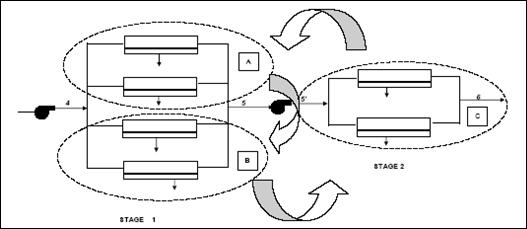
Figure 1: A simplified schematic of the flow reversal technique implemented for tapered flow arrangement of RO pressure vessels. Actual block rotation is effected by valving.
[1] Natalie Pomerantz, Yitzhak Ladizhansky, Eli Korin, Michael Waisman, Naphtali Daltrophe, and Jack Gilron, (2006), Prevention of Scaling of Reverse Osmosis Membranes by “Zeroing” the Elapsed Nucleation Time. Part I. Calcium Sulfate, Ind. Eng. Chem. Res. 2006, 45, 2008-2016
[2] Michal Uchymiak, Alex R. Bartman, Naphtali Daltrophe, Michael Weissman, Jack Gilron, Panagiotis D. Christofides, William J. Kaiser, Yoram Cohen, (2009) Brackish water reverse osmosis (BWRO) operation in feed flow reversal mode using an ex situ scale observation detector (EXSOD), J. Memb. Science, 341, 60-66.
[3] J. Gilron and E. Korin (2010), METHOD AND SYSTEM FOR INCREASING RECOVERY AND PREVENTING PRECIPITATION FOULING IN PRESSURE-DRIVEN MEMBRANE PROCESSES, EP 1691915.
[4] 2005 – J. Gilron, METHOD AND APPARATUS FOR REPOSITIONING FLOW ELEMENTS IN A TAPERED FLOW STRUCTURE, WO-2006/137068A2.
See more of this Group/Topical: Separations Division