
 Google
 Yelp
 Facebook
 Twitter
 ChEnected
254671 Biomasspyrolysisrefinery: A Two Step Approach for Liquid Energy Carrier Production From Lignocellulose
BiomassPyrolysisRefinery:
A two step approach for liquid energy carrier
production from lignocellulose
Lignocellulose
is expected to contribute to production of liquid and solid combustibles with
high potential for CO2 neutral processing. The “BiomassPyrolysisRefinery”
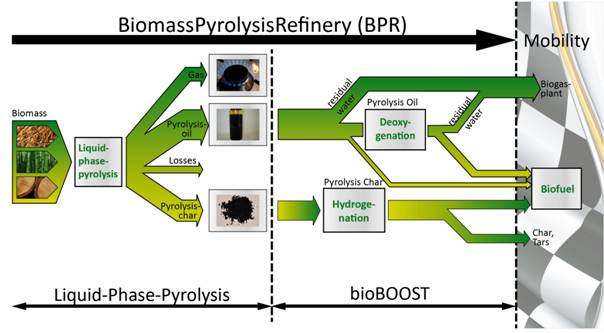
is a two step concept for biomass liquefaction and hydrogenation, as shown in
figure 1. First step of this concept is liquid phase pyrolysis: In this step a
significant amount of oxygen is removed under thermal load and the calorific
value of the lignocellulosic feed is partially condensed. Liquid phase pyrolysis
is an exothermic process. During dehydration at T=350°C about 25-28% liquid
CHO-products (biocrude) and about 38-42% BioChar is
formed. [1] Biocrude oil from
liquid phase pyrolysis passes then a dewatering step where almost 90% of water
from dehydration is separated. Afterwards the biocrude oil undergoes hydrodeoxygenation. After liquid
phase pyrolysis biochar is separated from the heat carrier and undergoes
hydrogenation as well gasification and water gas shift reaction. Through
hydrogenation of Biochar Hexane, Toluene (Asphaltenes)
and THF (Preasphaltenes) solubles
are formed.
Figure
1: BiomassPyrolysisRefinery concept 1. Schwaiger, N., et al., Liquid and Solid Products from Liquid-Phase
Pyrolysis of Softwood. Bioenergy Research, 2011. 4(4): p. 294-302.
See more of this Group/Topical: Fuels and Petrochemicals Division