
 Google
 Yelp
 Facebook
 Twitter
 ChEnected
255276 Microstructured Palladium-Based Membranes for Hydrogen Purification
Hydrogen Purification with Microstructured Palladium Alloy Composite Membranes
Zachary W. Dunbar and Deryn Chu
Abstract:
Portable fuel cells have potential to fill a unique power niche in the US Army for small to intermediate power demands, such as battery charging, drone power, small gensets, and auxillary power units. Mobile fuel reformation is sought by the Army to provide mobile hydrogen-on-demand for fuel cell applications, using logistic fuels as a hydrogen carrier. Unfortunately, running a fuel cell on pure logistic fuels reformate is troublesome, due to its high concentrations of carbon monoxide, hydrogen sulfide, and coking precursors.
To alleviate this issue, a purification step is necessary to clean up the gas stream being processed by the fuel cell. Palladium based membrane technology is an ideal candidate for this operation.
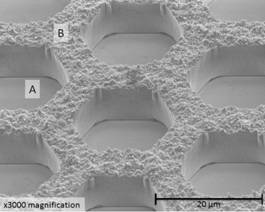
In this work, microfabrication processes are used to engineer a microstructured metallic support for both pure palladium and palladium-copper alloy membranes. The resulting membranes are entirely metallic, and have planar geometry. The active layer for hydrogen purification is varied between 250 and 500 nanometers, while the nickel mechanical support is approximately 10 microns in thickness. The membranes are tested under pure hydrogen and synthetic water gas shift atmospheres. Hydrogen flux, selectivity, hydrogen sulfide sensitivity and long term durability are evaluated.
|
Figure 1. Composite membrane (permeate side) A – palladium thin film; B – electroplated nickel metal for mechanical support
|
See more of this Group/Topical: Separations Division