
 Google
 Yelp
 Facebook
 Twitter
 ChEnected
258244 Influence of Particle Size and Microstructure On the Oxidation Behavior of Carbon Blacks and Diesel Soot
Atmospheric aerosol particles, defined as a suspension of a liquid or solid particle in a gas [1], are considered as air pollutants due to their impact on the environment, climate, and public health [2]. Among these pollutants, Diesel Particulate Matter (DPM) causes a significant impact on the global warming and health problems. DPM trapping by means of filtration and periodic filter regeneration by DPM combustion have been investigated [3]. Due to the highly complex nature, ambiguity, and unpredictability of the soot structure, Diesel Particulate Filter (DPF) optimization is a challenging task [4]. Previous studies have focused on some structural characterization of diesel soot formed under various diesel engine conditions [5,6] as well as of commercially available carbon blacks [7]. However, direct correlations between the important structural parameters and the reactivity under oxidative environments are lacking.
This work focuses on a comprehensive structure and activity investigation of ten commercially available carbon blacks and diesel engine soot. Particle sizes are determined using Scanning Electron Microscopy (SEM) and Transmission Electron Microscopy (TEM), while the microstructure has been investigated by X-ray Diffraction (XRD) peak profile analysis, Raman spectroscopy, and TEM (see Figure for examples). The activity of these samples is studied using Thermo Gravimetric Analysis (TGA) under an oxidative environment. Various structural parameters, such as the average particle size, degree of disorder, average stacking height, average crystallite diameter, extent of aggregation and the morphology of a single particle, are correlated with the TGA oxidation activity. Our analysis has indicated unique and previously unknown correlations between soot structure and reactivity. Specifically, it is observed that the average particle size, degree of disorder, and the morphology have a clear influence on the oxidation behavior of carbon black and diesel soot.
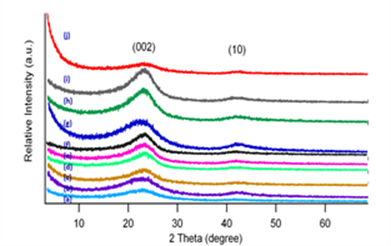
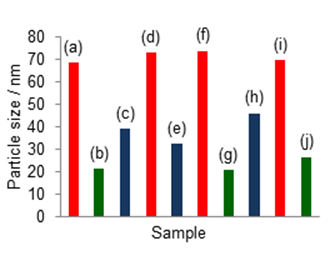
XRD patterns and average particle size distribution of (a) Printex U, (b) Monarch 1300, (c) Vulcan XC72R, (d) Monarch 280, (e) Regal 330 R, (f) Printex G, (g) Monarch 1400, (h) Regal 400 R, (i) Mogul E, and (j) Printex XE-2
References:
(1) Pöschl, U., Angew. Chem. Int. Ed. 2005, 44, 7520 – 7540.
(2) Knauer, M., Schuster, M.E., Su, D., Schlogl, R., Niessner, R., and Ivelva N.P., J. Phys. Chem. A, 2009, 113, 13871-13880.
(3) van Setten, B.A. A. L., Makkee, M., and Moulijn J.A., Catalysis Reviews: Science and Engineering, 2001, 43(4), 489-564.
(4) Stanmore, B. R., Brilhac, J.F., and Gilot, P., Carbon, 2001, 39, 2247-2268.
(5) Ungar, T., Gubicza, J., Ribarik, G., Pantea, C., and Zerda, T.W., Carbon, 2002, 40, 929-937.
(6) Kirchner, U., Vogt, R., Natzeck, C., Goschnick, J., Aerosol Science, 2003, 34, 1323 - 1346.
(7) Muller, J.O., Su, D.S., Jentoft, R.E., Wild, U., and Schlogl, R., Environmental Science & Technology, 2006, 40, 1231-1236.
See more of this Group/Topical: Catalysis and Reaction Engineering Division