
 Google
 Yelp
 Facebook
 Twitter
 ChEnected
259285 Simulations of Mobilization of Bingham Layers in Agitated Tanks
Simulations of mobilization of Bingham layers in agitated tanks
Numerical simulations were used to study mobilization of a bottom layer of Bingham liquid by agitating a Newtonian liquid above the Bingham layer. The agitation is done by a pitched-blade impeller at a Reynolds number of 6000. The Bingham liquid and the Newtonian liquid are miscible. The parameter space of the simulations has a Bingham number Bn (defined as the ratio of yield stress over inertial stress) and a Richardson number Ri as dimensionless variables. The Richardson number quantifies the role of the density difference between the two liquids. The simulation procedure is based on the lattice-Boltzmann method for the flow dynamics, and a finite volume scheme to solve the local and time dependent composition of the liquid mixture. The moderate Reynolds number allows us to directly simulate the flow, without the use of turbulence closure or subgrid-scale models.
The simulations show how the bottom layer gets eroded by the turbulent flow above it (see the figure), and show that there exists a critical value of the Bingham number beyond which the turbulent flow is not able to remove the Bingham layer (compare the left and right panel of the figure). The Richardson number is less important for the mobilization process, but has impact on the time it takes for homogenization of the liquids after mobilization has occurred.
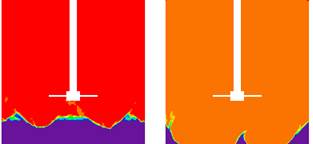
Figure: cross section through the mixing tank 100 impeller revolutions after start-up; left Bn=0.8, right Bn=0.1; blue indicates the Bingham liquid.
See more of this Group/Topical: North American Mixing Forum