
 Google
 Yelp
 Facebook
 Twitter
 ChEnected
260038 Effects of Sodium Substituted Solid Base ZrO2 On the Hydrogenolysis of Phenethyl Phenyl Ether (PPE) in near-Critical Water
Lignin is uneatable biomass and large amounts of lignin are produced by the lignocellulosics biomass-to-ethanol process and by pulp & paper refineries process as waste. Most of it is burned as low-grade fuel. However, the complex chemical structure of aromatic groups in lignin suggests that it may be a good source of valuable aromatic chemicals if it could be broken into smaller molecular units. Phenethyl phenyl ether (PPE), model substance of the b-O-4 linkage prevalent in lignin, was hydrolyzed in near-critical water. The influence of Na-ZrO2 base catalyst on these reactions was tested at 400° for 0.5~2 h. The prepared Na-ZrO2 catalysts were characterized by several methods (BET, XRD, ICP and CO2-TPD) to investigate the relationship between its physicochemical structure and the activity in PPE hydrogenolysis. The valuable chemicals such as phenol, styrene and ethyl benzene were largely produced by the hydrogenolysis reaction of PPE.
Na-ZrO2 catalysts were prepared by precipitation method. 3.0 g of amphiphilic block copolymers (PEO20PPO70PEO20, Pluronic P 123) was dissolved in a 110.6 g of absolute ethanol and 13.4 g of zirconium (IV) n-propoxide (70 wt.% solution in 1-propanol) were separately dissolved with 1.5 g of acetylacetone under stirring. Then above two solutions were mixed under vigorous stirring. Upon stirring at room temperature for 1 h, 5.4 g of deionized water was added dropwise. The mixture was gelated in a closed vessel at 60° for 48 h and the obtained transparent resin hybrid was partly refluxed in the vessel with 0.5 mol/L NaOH aqueous solution for another 48 h. Then the suspension was washed thoroughly with deionized water and drying at 100° for 24 h. Finally, the samples were calcined at 700° for 5 h (ramping rate: 1°/min)
Reaction tests were performed in a stainless-steel-tube (SUS 316) bomb reactor with a volume of 5 mL. The reactor was loaded with 4 ml of deionized water containing 2.5 wt.% PPE and 0.1 g of prepared catalysts. And then pressurized to 20 bar with gaseous hydrogen (ultra high purity, >99.999%). The reactor was then placed into an electric furnace and quickly heated to the reaction temperature. After the reaction, the reactor was removed from the electric furnace and quickly quenched to room temperature. The mixture of reactants and products was diluted with THF to a volume of 12 mL. The reaction products were analyzed by gas chromatography–mass spectroscopy (GC-MS, Aglient 6890 GC coupled with 5973N mass selective detector, column: Restek, Rxi-5Sil MS, 30 m•0.25 mm•0.25 mm).
The Na-ZrO2 catalyst showed the higher basicity than pure ZrO2 (from CO2-TPD results, abbreviated) and the PPE conversion and the yields of the valuable products increased sharply. As the reaction time increased, the conversion of PPE and the product yields increased but above 2 h reaction, the yields of phenol and ethyl benzene decreased sharply while the conversion of PPE was 95%. This result was due to the consecutive reaction to form the repolymerization product (char) was occurred between reactive intermediate like phenolic radicals.
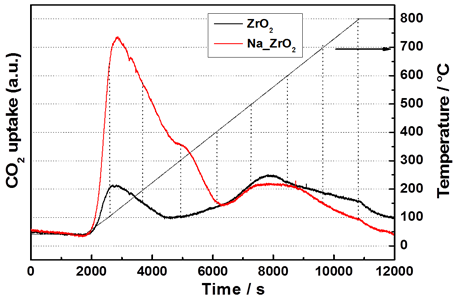
Figure 1. CO2–TPD profiles of pure zirconia and the as-made Na–ZrO2
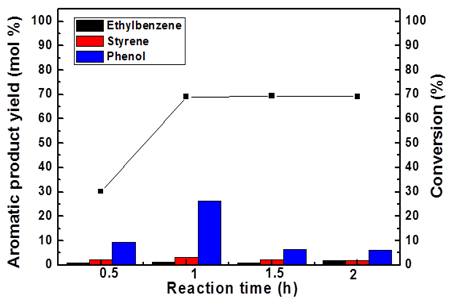
Figure 2. . PPE conversion and product yields at different reaction times (4 mL of aqueous solvent; 0.1g of PPE; non-catalyst; reaction temperature: 400°; initial pressure: 20 bar H2; reaction time: 0.5~2 h).
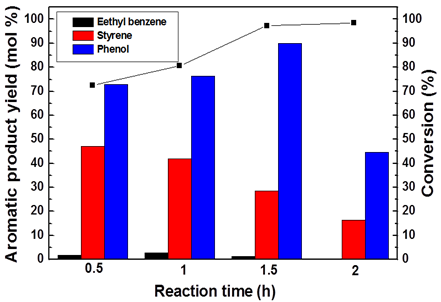
Figure 3. PPE conversion and product yields at different reaction times (4 mL of aqueous solvent; 0.1g of PPE; 0.1 g of Na-ZrO2; reaction temperature: 400°; initial pressure: 20 bar H2; reaction time: 0.5~2 h).
See more of this Group/Topical: Catalysis and Reaction Engineering Division