
 Google
 Yelp
 Facebook
 Twitter
 ChEnected
261845 Similarities and Differences Between NHC- and Pincer Nickel Complex-Catalyzed CO2 Transformations Into Methanol: Mechanistic Insight From DFT Calculations
Similarities and Differences between NHC- and Pincer Nickel Complex-Catalyzed CO2 Transformations into Methanol: Mechanistic Insight from DFT Calculations
Fang Huang and Zhi-Xiang Wang*
Graduate University of Chinese Academy of Sciences Beijing,100049, China
Keywords: Catalytic CO2 transformation, Methanol, DFT mechanistic study
Abstract: The transformation of CO2 into value-added compounds such as methanol is a promising strategy to utilize the abundant and cheap CO2 resource. Recently, Zhang et al.[1] used N-hetrocyclic carbene (NHC) as the catalyst and silanes as hydrogen sources to convert CO2 into methanol. Guan el al. [2] employed the pincer nickel complex (tBuPCPNiH, [Ni]H) as the catalyst and catecholborane (HBcat) as hydrogen source to transform CO2 into methanol. The two reactions represent the first example for such a transformation in the organic and organometallic catalysis, respectively. Using DFT calculations, we [3-4] gained insight into how the two catalytic transformations take place. Interestingly, in spite of the different catalysts, the two transformations share similarities. Both transformations utilize three steps to transfer Hd- to CO2 or CO2-containing intermediate species step and step. However, the Hd- transfer mechanisms are different. [Ni]H catalyst uses 'lending and then borrowing" strategy to transfer Hd- from hydrogen source (HBcat) to CO2/HCOOBcat/CH2O, while NHC pushes/facilitates the direct Hd- transfer from hydrogen source (silane) to CO2/HCOO[Si]/CH2O. [Ni]H catalyst itself, as a reactant, participates in the each reaction step and then retrieves as the transformation proceeds. In contrast, NHC catalyst never changes its integrity in the transformation process. Because of the similarities and different Hd--transfer mechanisms, the mechanistic details are different, as illustrated by Figure 1(B). According to the mechanistic details, we give suggestions on how to develop effective catalysts to realize such transformation.
A
| B
|
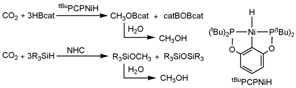
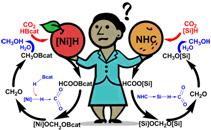
Figure 1: A) Two experimental transformations. B) Similarities and differences between the two transformations.
[1] Riduan, S. N.; Zhang, Y. G.; Ying J. Y.: Angew. Chem. Int. Ed., 2009, 48, 3322. [2] Chakraborty, S.; Zhang, J.; Krause, J. A.; Guan, H. R. J. Am. Chem. Soc. 2010, 132, 8872. [3] Huang, F.; Lu, G.; Zhao, L.; Li, H.; Wang Z.-X.: J. Am. Chem. Soc., 2010, 132,
12388. [4] Huang F.; Zhang, C. G.; Jiang, J. L.; Wang, Z. X. Inorg. Chem.
2011, 50, 3816.
See more of this Group/Topical: Catalysis and Reaction Engineering Division