
 Google
 Yelp
 Facebook
 Twitter
 ChEnected
261895 Effect of the Flow Field of An Internally Spout-Fluid Bed On Dispersion of Glass Fibre for Thermoplastic Composites Manufacture
Effect of the Flow Field of an Internally Spout-fluid Bed on Dispersion of Glass Fiber for Thermoplastic Composites Manufacture
Yuan Zonga, Xiaogang Yangb, Gance Daia, Ling Zhaoa*
a Department of Chemical Engineering
East China University of Science and Technology, Shanghai 200239 China
b Institute for Arts, Science and Technology
Glyndŵr University, Wrexham, LL11 2AW UK
*Corresponding Author's E-mails: zhaoling@ecust.edu.cn
Keywords: Fibre flocs; Dispersion; Spout-fluid bed; Numerical simulation
Abstract
The mechanical and thermal properties of glass fibre-reinforced thermoplastics have close relationship with the impregnation of glass fiber by high viscosity resin. A novel methodology of dispersion and pre-mixing for components integratedly by applying a modified spout-fluid bed has been pioneered by State Key Laboratory of Chemical Engineering (China). The modified spout-fluid bed was mounted draft tube and disk-baffle to endow it with special flow field. The mechanics of fiber dispersion in the internally spout-fluid bed was investigated using Large Eddy Simulation (LES) modeling and reported in a previous paper (Zong, Yang and Dai, 2011). This study attempts to reveal correlations between fibre dispersion and the flow field by numerical simulation. The motion of fibers was modeled by species transport equation, coupled with the turbulent shear flow in the spout-fluid bed. The correlation between the fibre concentration and local vorticity was obtained from the simulation. The results showed existence of a strong correlation between the glass fiber concentration and local vorticity. A local high vorticity corresponds a relatively high glass fiber concentration. Due to the addition of the internals (draft tube and disk-baffle) into the spout-fluid bed, the flow field were significantly altered and has a characteristics of relatively uniquely distribution of high turbulence, which was proved to be benefit to the manufacture of fiber reinforced thermoplastic.
References
1. Zong, Y., Yang, X. and Dai, G. (2011) Design simulation of glass-fiber-loaded flow in an internally spout-fluidized bed for processing of thermoplastic composites. I. Flow characterization. Ind. Eng. Chem. Res. 2011, 50(15), pp. 9181-9196 .
Figures
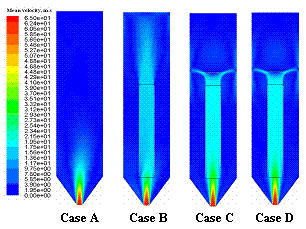
Fig.1. Time-averaged LES velocity distributions
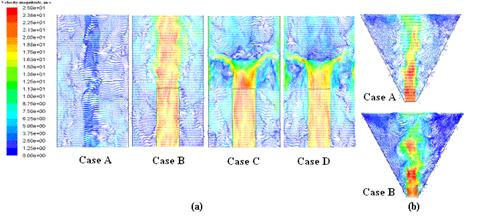
Fig. 2 Velocity vector in entry region and impinging region. (a) impinging region; (b) entry region.
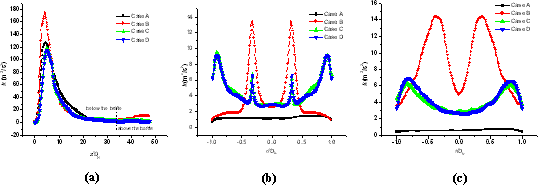
Fig. 3 Turbulent kinetic energy distribution at different position( DN is the diameter of the spouting nozzle). (a ) Along the centerline; (b) impinging region z/DN=32.2;(c) outlet region z/DN=38.9.
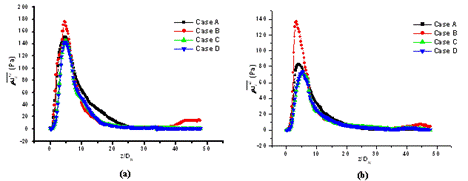
Fig. 4 Axial Reynolds stress along the centerline. (a) ¦Ñuz'2;(b) ¦Ñur'2
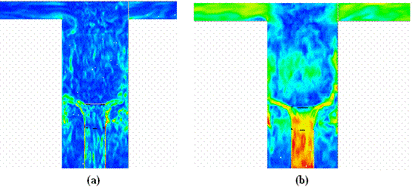
Fig. 5 Vorticity distribution and corresponding fiber distribution inside the reactor. (a) Vorticity distribution ; (b) Fiber concentration distribution
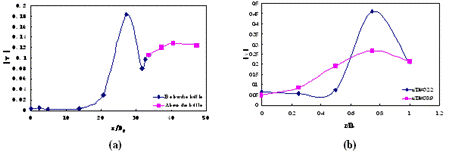
Fig.6 Distribution of correlation coefficient |¦Ã| at different position.( a) axial distribution along the centerline;(b) radial distributions at z/Db=32.2 and z/Db=38.9 .
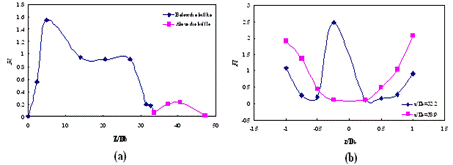
Fig.7 Profiles of flocculation intensity (Fl) at different location. (a) axial distribution along the centerline£»(b) radial distributions at z/Db=32.2 and z/Db=38.9 .
See more of this Group/Topical: Particle Technology Forum