
 Google
 Yelp
 Facebook
 Twitter
 ChEnected
266609 Computational Analysis of the Air Injection Effect On the Regeneration Process in FCC
One of the problems associated with regeneration process in conventional fluid catalytic cracking (FCC) unit is the increase of flue gas temperature after leaving the dense catalyst bed, afterburning phenomena. Generation of excessive heat of combustion and presence of smaller number of catalyst particles to absorb this heat may degrade the quality of catalyst, and require additional fresh catalyst to maintain the proper working FCC unit. Hydrodynamic approach for gas-solid flows in fluidized bed is the best way to comprehend regeneration process including afterburning problem, and consequently a step-out improvement of the FCC regeneration. In this work, a regeneration process in a simple type regenerator was investigated by computational particle fluid dynamics (CPFD) numerical simulation which is Eulerian-Lagrangian solution method for fluid-solid multiphase flows. The combustion reaction was considered as a stoichiometric equation in the simulation scheme. The simulated temperature profile of catalyst and the particle-fluid coupled behaviour shows persuasive accuracy with experimental data. Figures 1 and 2 below represent simulated temperature profiles of gas and catalyst particle, respectively. The air distribution effect on regeneration tendency was also demonstrated for various types of air sparger and air inlet flow rate conditions. The results reveal that adjustment of air flow gives significantly better temperature distribution, and hence dramatically decrease ratio of the over-heated catalyst caused by afterburning effect.
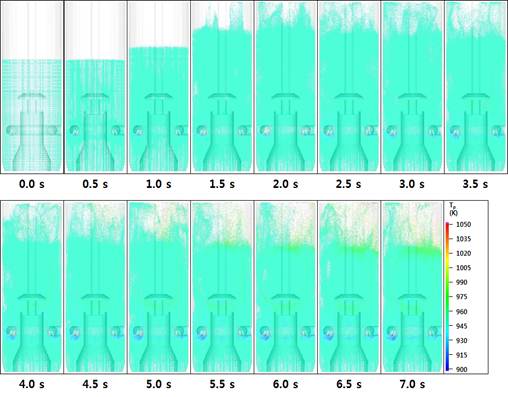
Figure SEQ Figure \* ARABIC 1. Temperature profile of catalyst particles
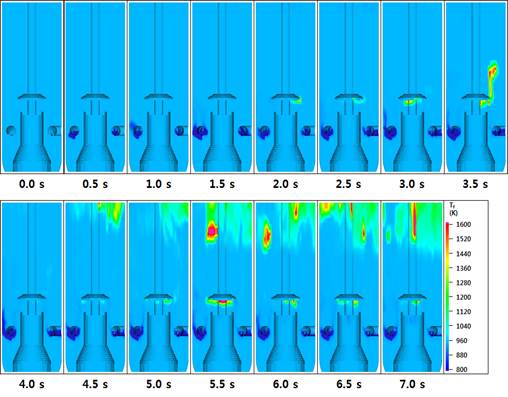
Figure SEQ Figure \* ARABIC 2. Temperature profile of gas
Reference
[1] D. M. Snider, S. M. Clark and Peter J. O'Rourke, Eulerian–Lagrangian method for three-dimensional thermal reacting flow with application to coal gasifiers, Chemical Engineering Science, 66(6), 1285–1295 (2011).
[2] P. Zhao, P. J. O'Rourke and D. Snider, Three-dimensional simulation of liquid injection, film formation and transport, in fluidized beds, Particuology, 7(5), 337-346 (2009).
[3] P. J. O'Rourke, P. Zhao and D. Snider, A model for collisional exchange in gas/liquid/solid fluidized beds, Chemical Engineering Science, 64(8), 1784-1797 (2009).
[4] C. Y. Wen and Y. H. Yu, Mechanics of fluidization, Chemical Engineering progress Symposium Series, 62(62), 100-111 (1966).
[5] V. L. Zimont and Y. M. Trushin, Total combustion kinetics of hydrocarbon fuels, Combustion, Explosion, and Shock Waves, 5(4), 391-394 (1969).
[6] Yeong-Koo Yeo, Hee-Young Kim, In-Won Kim, Il Moon, Yonsoo Chung and V. V. Levdansky, Analysis of catalytic reaction systems under microwaves to save energy, Korean Journal of Chemical Engineering, 20(1), 1-7 (2003).
[7] V. A. Danilov, Jongkoo Lim, and Il Moon, Three-dimensional two-phase CFD model for DMFC design, Journal of Power Source, 162(2), 992-1002 (2006).
See more of this Group/Topical: Particle Technology Forum