
 Google
 Yelp
 Facebook
 Twitter
 ChEnected
271260 Novel Solvent Selection and Solvent Stripping for CO2 Capture From Power Plants
Novel Solvent Selection and Solvent Stripping for CO2 Capture from Power Plants
Juan Salazar and Urmila Diwekar
Center for Uncertain Systems: Tools for Optimization & Management
Vishwamitra Research Institute
Clarendon Hills, IL 60514
E-mail: urmila@vri-custom.org; Tel: 630-886-3047
And
Kevin Joback
Molecular Knowledge Systems, Inc.
Bedford, NH 03110-0755
And
Abhoyjit S. Bhown
Electric Power Research Institute, Inc.
Palo Alto, CA 94304
This paper presents a new approach to solvent selection for post-combustion CO2 capture from fossil fuel fired power plants. Two main questions arise in a solvent capture process: how to select an effective separating agent and how to design and synthesize this separation process. In previous studies, few solvents were considered for CO2 capture. Further, researchers arrived at these solvents using experimental methods with limited capacity to screen a large number possible candidates. In this work, we are using computer aided molecular design (CAMD) method to obtain a large number of possible solvent candidates. These candidates are then evaluated by integrating the solvent selection and CO2 capture process to ensure improved energy, environmental, and economic performance. In this paper we present the first attempt at using group contribution based CAMD to derive new solvents for CO2 capture.
CO2 absorption in a solvent-based capture process is essentially based on the reversible, selective nature of the chemical reaction between the liquid solvent and CO2 in the flue gas. The process flow diagram shown in Figure 1 has been widely used in literature. Flue gas from the boiler is brought into contact with the solvent in the absorber after the removal of impurities such as NOx, SOx and particulate matter using processes that also cool the flue gas. A blower is used to compensate the pressure drop experienced in the absorber. In the absorber, CO2 selectively absorbs into the solvent, and flue gas leaving the absorber is relatively free of CO2. The CO2-rich solvent from the absorber is then pumped to the top of a stripper (or regeneration vessel), via a heat exchanger. Solvent is regenerated in the stripper at elevated temperatures and near atmospheric pressure. The desorption heat required for removing the absorbed CO2 is provided to the reboiler section of the stripper. The CO2-lean solvent, containing far less CO2 is then pumped back to the absorber via a lean-rich heat exchanger to cool it to the operating temperature of the absorber. We used this process diagram to evaluate new solvents.
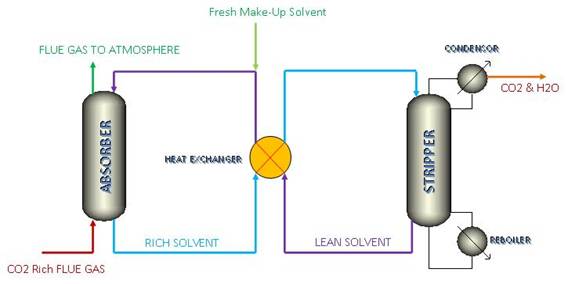
Figure SEQ Figure \* ARABIC \s 1 1
Base Absorption Process Flowsheet for CO2
Capture
In our CAMD approach, we concentrated on amines. In order to use group contribution methods,
at first we analyzed the equilibrium performance for these new amines for
absorption (CO2 capture) and for regeneration (solvent
stripping). The CAMD resulted in a list
that included a group of more than 50 alkyl alcohol amines whose CO2
solubility properties have not been experimentally determined as far as we
know. We evaluated these solvents using ASPEN
Plus models and group contribution methods like UNIFAC to evaluate the nonideality. Figure
2
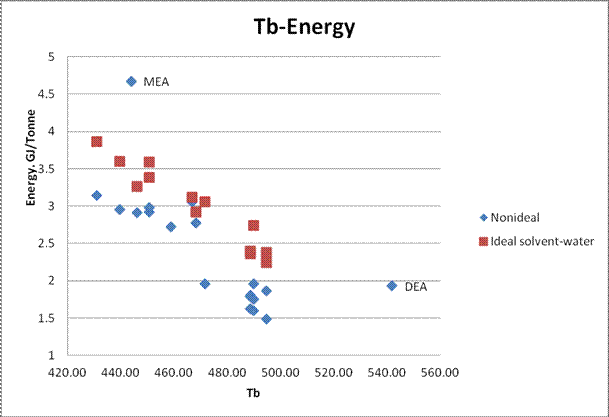
Figure SEQ Figure
\* ARABIC \s 1 2
Energy Requirements for the New Solvents
See more of this Group/Topical: Sustainable Engineering Forum