
 Google
 Yelp
 Facebook
 Twitter
 ChEnected
271317 Sustained Release Systems to Locally Expand Regulatory T Cell Populations and Suppress Inflammation
Aberrant inflammation leading to tissue destruction is responsible for transplant rejection, autoimmunity, and inflammatory diseases. Traditional therapies involve harsh regimens of systemic immunosuppression, which leave patients vulnerable to opportunistic infections. Consequently, there is considerable interest in developing novel methods to localize suppression to inflamed tissue.1 One such therapeutic approach involves increasing the presence of suppressive regulatory T cells (Treg) at local sites,2 which typically requires systemic infusion of ex vivo cultured cells.3 As inspiration for an alternative method to increase Treg locally, we consider a naturally occurring mechanism employed by the immune system. Specifically, tolerogenic dendritic cells induce the differentiation of naive T cells to Treg by establishing a local immunosuppressive milieu, comprised of secreted cytokines (IL-2 and TGF-β).4 In an inflammatory microenvironment, these factors may be insufficient to prevent differentiation of naive T cells to pro-inflammatory effector T cells; however, the immunosuppressant drug rapamycin (rapa) has been shown to preferentially suppress generation and proliferation of effector T cells, but not Treg.5 With this rationale, we have developed and tested biomimetic sustained release microparticle (MP) formulations of various factors, including IL-2, TGF-β, and rapa (collectively FactorMP), which can dramatically increase populations of Treg in vitro and suppress local inflammation in a murine model of contact hypersensitivity.
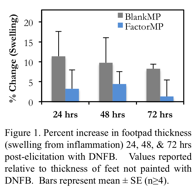
To fabricate sustained release cytokine/drug formulations, IL-2, TGF-β, and rapamycin (rapa) were encapsulated in poly(lactic-co-glycolic acid) (PLGA) using emulsion-evaporation techniques, and the resulting FactorMP were characterized, as described elsewhere.6 Empty PLGA MP (BlankMP) were used as controls. For in vitro Treg induction assays, na•ve CD4 T cells were cultured in the presence of the soluble or encapsulated cytokines and drugs. At day 4, cell phenotypes were analyzed by flow cytometry, and suppressive function was assessed by a standard mixed leukocyte reaction. For the contact hypersensitivity suppression study, either FactorMP or BlankMP were injected into the footpads of mice at days -11 and -6. On day -5, mice were sensitized with dinitrofluorobenzene (DNFB). A contact hypersensitivity response was elicited on day 1 by painting one footpad with DNFB, and measurements of footpad thickness (indicative of inflammation) were taken at 24, 48, and 72 hours post-elicitation. Subsequently, draining lymph nodes were isolated and T cell populations analyzed by flow cytometry.
 IL-2,
TGF-β, and rapa were
successfully encapsulated in PLGA MP, with sizes ranging from 16.7±6.3 to 25.5±7.5μm
(large enough to remain at an injection site). Each MP formulation provided sustained
release of the encapsulated factor for at least 3 weeks in vitro, creating a sustained immunosuppressive, local
microenvironment. Similar in vitro Treg induction efficiencies
were observed for naive CD4 T cells cultured in the presence of FactorMP or
soluble factors. Notably, the
presence of soluble rapa or rapaMP, significantly (p<0.05) enhanced induction
efficiency from 57±18% (with IL-2 and TGF-β alone) to 71±15%. Importantly, induced Treg expressed
canonical Treg surface markers (CD25 and GITR), as well as FoxP3, a
characteristic Treg transcription factor.
Furthermore, FactorMP-induced Treg were
functionally suppressive in a mixed leukocyte reaction. Finally, data from a contact
hypersensitivity model (Figure 1) suggests that establishment of a local
immunosuppressive milieu by FactorMP can decrease footpad swelling (local
inflammation), presumably by increasing local Treg numbers.
In conclusion, we have successfully fabricated MP that provide sustained release of Treg-inducing factors. These FactorMP significantly increase numbers of functional Treg in vitro. Preliminary results also suggest that they can suppress inflammation in vivo. Ultimately, this FactorMP system may have the potential to treat a variety of inflammatory and autoimmune diseases, as well as transplant rejection.
[1] Thomson AW (ed). Immunology and Medicine: Therapeutic Immunosuppression (2001) Springer; 29:1-512.
[2] Sakaguchi S et al. Immunol Rev (2001) 182:18-32.
[3] Raimondi G et al. J Immunol (2010) 184:624-36.
[4] Horwitz DA et al. Eur J Immunol (2008) 38:901-937.
[5] Battaglia M et al. Blood (2005) 105:4743-4748.
[6] Jhunjhunwala S et al. J Control Release (2012) 159:78-84.
See more of this Group/Topical: Food, Pharmaceutical & Bioengineering Division - See also TI: Comprehensive Quality by Design in Pharmaceutical Development and Manufacture