
 Google
 Yelp
 Facebook
 Twitter
 ChEnected
274758 Evaluating the Contribution of Direct Vs. Indirect Carbonate Production in Anion Exchange Membrane Fuel Cells
Evaluating the Contribution of Direct vs. Indirect Carbonate Production in Anion Exchange Membrane Fuel Cells
Michael Ignatowich, Gregory Crettol, Molly Chhiv and William E. Mustain
Department of Chemical, Materials and Biomolecular Engineering; University of Connecticut
Storrs, CT 06268
One of the most widely discussed topics in the development of anion exchange membrane fuel cells (AEMFC) is the formation of carbonate/bicarbonate anions at the AEMFC anode. For the hydroxide exchange membrane fuel cell, carbonate formation is considered a poison that reduces electrolyte conductivity during operation, mostly through the formation of bicarbonate. In the carbonate exchange membrane fuel cell, the high selectivity of carbonate is required to enable high electrolyte stability while limiting the formation of bicarbonate anions.
In both devices, there are two primary routes through which carbonate anions can be formed: direct electrochemical reduction of O2 and CO2, and the indirect formation of carbonate through the reaction of hydroxide with CO2. These two pathways are shown below.
Direct Pathway:
O2 + 2CO2 + 4e- ¦ 2CO3-2 (1)
Indirect Pathway:
O2 + 2H2O + 4e- ¦ 4OH- (2)
OH- + CO2 ¦ HCO3- (3)
HCO3- + OH- ¦ CO3-2 + H2O (4)
The context for this talk will primarily be the evaluation of new catalysts for carbonate exchange membrane fuel cells [1-2], though the analysis presented is directly application to all AEMFCs. Here, we have constructed an anion exchange membrane fuel cell with the catalysts of interest at the cathode, a commercial anion exchange membrane fuel cell and Pt/C at the anode. A humidified mixture of O2 and CO2 was fed to the cathode and humidified H2 to the anode. At the anode, hydrogen is efficiently oxidized by both CO3-2 and OH- [3], which allows us to assume that all of the charge-carrying carbonate anions are oxidized to CO2 (Equation 5).
H2 + CO3-2 ¦ CO2 + H2O + 2e- (5)
The effluent of the fuel cell was fed to a 0.1M Ca(OH)2 solution, which enable the precipitation of CaCO3, giving a direct measure of the amount of charge-carrying carbonate. A schematic for this cell is shown in Figure 1.
In this work, on-off AC polarography was used to precisely control the relative contribution of the indirect chemical and direct electrochemical formation of carbonate on each catalyst. During “device on” conditions, both the chemical and electrochemical routes are active, while “device off” conditions limit the cell to the indirect pathway only. Various ratios of on-off times act in a manner similar to standard addition experiments in analytical chemistry, allowing for amount of carbonate formed electrocatalytically to be quantified for the first time.
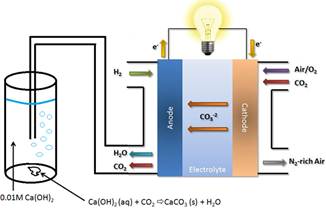
Figure 1 – Improvement in anion exchange membrane stability in the carbonate/bicarbonate form (b) compared to hydroxide (a).
Preliminary results show that Ca2Ru2O7 has a significantly improved direct pathway carbonate selectivity compared to Pt/C, making it a very good candidate catalyst for carbonate exchange membrane fuel cells. This work also confirms that the primary route for carbonate formation on Pt-based catalysts is through the indirect pathway.
References:
1. J. Vega, S. Shrestha, M. Ignatowich, W. Mustain. J. Electrochem. Soc., 159 (2012) B12.
2. J. Vega, N. Spinner, M. Catanese, W. Mustain. J. Electrochem. Soc., 159 (2012) B19.
3. J.A. Vega, S. Smith and W.E. Mustain, J. Electrochem. Soc., 158 (2011) B349
See more of this Group/Topical: Catalysis and Reaction Engineering Division