
 Google
 Yelp
 Facebook
 Twitter
 ChEnected
275093 Analytic Solutions of the Poisson-Boltzmann Equation for Nanochannels and Confined Spaces
The electrostatic potential between charged interfaces is very important for a wide range of phenomena related to chemistry and physics of solutions. Examples include theory of electrolytes, colloid stability, and electrokinetic phenomena. The electrostatic potential in electrolyte solutions is given by the nonlinear Poisson-Boltzmann equation. This equation can be linearized for low potentials (_26 mV at room temperature.)
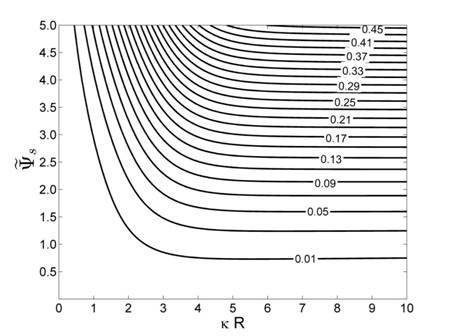
The case of high potentials and small separations between the charged surfaces is particularly difficult to simplify. In this paper we suggest a linearization procedure that is applicable to arbitrarily high potentials and works best in the case of small separations. This makes our approach particularly suitable for modeling nanofluidic channels. It allows us to obtain simple expressions for the potential distribution for a variety of channel shapes. We show that the analytical results can be presented in a mathematical form that is invariant for different system geometries. Figure 1 shows the mean error for the potential distribution in a cylindrical capillary. The error increases with the capillary radius, or alternatively the electrolyte concentration (inverse screening length k.) For large radii or high electrolyte concentrations,an alternative solution is derived that is based using the method of matched asymptotic expansions.
|
See more of this Group/Topical: Topical 3: 2012 Annual Meeting of the American Electrophoresis Society (AES)