
 Google
 Yelp
 Facebook
 Twitter
 ChEnected
276098 Fluid Bed in a Flash
Fluid Bed in a Flash
O. Scheibelhofer1, Roland Hohl1, Sharareh Salar Behzadi1, Detlev Haack2, Kai Koch3, Stefan Sacher1, Jose C. Menezes1, J. G. Khinast1,4
1 Research Center Pharmaceutical Engineering GmbH, Graz, Austria
2 Hermes Arzneimittel GmbH, Munich, Germany
3 Innojet Herbert Hüttlin, Steinen, Germany
4 Institute for Process and Particle Engineering, Graz University of Technology, Graz, Austria
Email for correspondence: otto.scheibelhofer@rcpe.at
(O. Scheibelhofer),
khinast@tugraz.at (J.G. Khinast)
Fluid Beds are a versatile and widely used unit operation in the pharmaceutical industry. Putting to use their property of very large particle to air contact surface, they are an advanced step for drying, coating and more. A great deal of interest has already been invested, concerning the properties of fluid beds, especially their geometry and flow pattern. Mostly, this is a field for simulations.
Nonetheless, the efficiency of fluid beds is often driven by the experience of their operators. This is a result of fluid beds being very sensitive to subtle changes, which can affect the flow pattern significantly, even dis-enabling the fluid bed process as a whole. Even more so, this increases the difficulty of placing sensors in such environment, making systematic experimental investigations an exhaustive work.
To overcome some of these difficulties, near-infrared spectroscopy seems a natural choice, for two reasons. First, the method is non-invasive, or even contactless, so to avoid the disturbance of the established flow pattern. Secondly, the method can be very fast and can therefore cope with the time-scale of flow inside the bed.
A single NIR probe is used for monitoring the fluid bed and following the trajectory of our process, for this a process NIR from Sentronic is used.
However, as there are different zones of flow and progress inside the bed, a single probe is not enough, to get an idea of the overall maturity inside the fluid bed.
Here we used a new spectrometer prototype provided by EVK, Raaba, Austria in order the monitor a coating process. The prototype is based on a push-broom principle, but instead of a line, a standardized port plate enables the mapping of different near-infrared probes, via a prism-grating-prism system onto the detection chip. As a consequence, several positions inside the fluid bed can be monitored simultaneously, with a frequency of several Hz. even more, the records of the probes can be directly compared, as they are guaranteed to be recorded at the same time, and there is no spectrometer drift in between probes, etc.
The probes are distributed inside the fluid bed vessel at carefully chosen positions, at the wall, in order to not disturb the flow pattern, but give at the same time the most relevant information.
The information gained is of value twofold. First, it tells about the process itself, and can be used to estimate necessary process time and quality. Second, it tells about the mechanisms inside the fluid bed, spatial differences, etc.; which is very valuable for final probe positioning, the task of up-scaling, and more.
Estimation of the sample positions and the process is done with risk analysis, and design of experiments is also used for generating an experimental setup pattern. Within the multiprobe measurement system, we will also evaluate the sample position of the single probe.
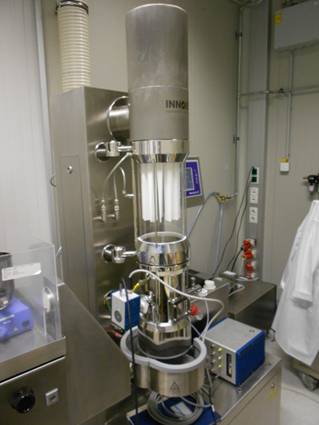
Figure 1: The Ventilus 2.5 fluid bed reactor is shown., with the Sentronic NIR probe attached.
See more of this Group/Topical: Topical I: Comprehensive Quality by Design in Pharmaceutical Development and Manufacture