
 Google
 Yelp
 Facebook
 Twitter
 ChEnected
276440 Forecasting Naphtha Crack Based On Multiple Regression and System Dynamics
Naphtha prices directly depend on crude oil prices
since naphtha is produced by refining crude oil. Naphtha plays an important
role as one of basic petrochemicals for downstream products. Uncertainty in forecasting naphtha
price has increased due to expanding price variability of naphtha affected by various
factors. Therefore, forecasting naphtha crack (price difference between naphtha and crude
oil) is a major requirement for decision making and planning. Several studies about price forecasting have
been published. In this paper, we considered two methods: multiple regression
model [1] and system dynamics model [2] for forecasting the naphtha price. This
study is concerned with the derivation of a set of major parameters affecting
naphtha prices and identification of the most dominating factors. Naphtha price
depends mainly on Asia demand and supply of naphtha as well as naphtha
substitute, margin, global economy and operational rate of oil company. The
data for these factors are collected from March 2007 to November 2011 except
from October 2008 to March 2009 to avoid unusual economic effect, Lehman
brothers collapse. In multiple regression model based on statistical approach used
data from March 2007 to December 2010 (training period). This model has been verified
by comparing naphtha crack trend of actual naphtha crack and predicted naphtha
crack from January 2011 to November 2011(forecasting period). In forecasting, the
trend of naphtha crack is more important than the accurate value of naphtha
crack. Therefore, we focus on the direction of predicted naphtha crack. Figure 1.
shows actual naphtha crack and predicted naphtha crack in training period. From
this period, R2
 of this model is 91.8%. This means that
91.8% of the variations in naphtha crack can be explained by the major factors.
Figure 2. presents actual naphtha crack and predicted naphtha crack forecasting
period. The trend of naphtha crack is more important than precise naphtha
crack.
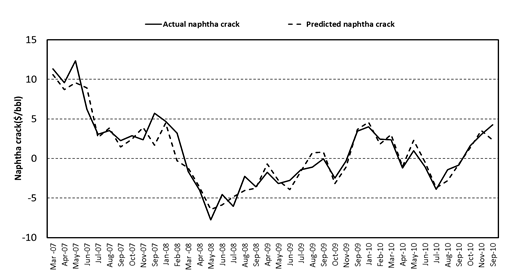
Figure 1. Time series plot of actual naphtha crack and predicted naphtha crack for training.
(From March 2007 to December 2010)
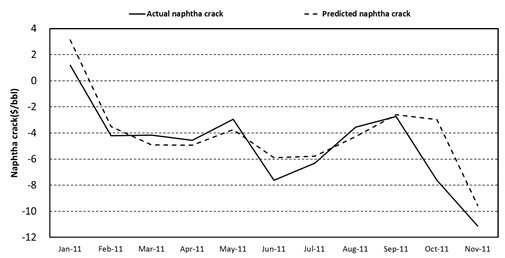
Figure 2. Time series plot of actual naphtha crack and predicted naphtha crack for forecasting.
(From January 2011 to November 2011)
Owing to 9 same predictions out of total 10 months in forecasting period, the percentage of correct predicted trend is 90%. Also, a model of forecasting naphtha crack is presented that is based on system dynamics. System dynamics is thinking model and simulation methodology. This model supports the study in complex systems. Therefore, this model is developed to support the changing petroleum markets. We draw a causal loop diagram for this model. This model forecasts naphtha crack and shows the relations among major factors. We presented two approaches for forecasting naphtha crack. Between two methods, we suggest higher percentage of correct predicted naphtha crack trend and the best approach in forecasting naphtha crack. The modeling approaches can be extended to forecast prices of other downstream chemicals such as LPG and NGL.
Keywords: Naphtha crack, Multiple regression, System dynamics, Forecasting
References
1. W. Zhang, H. Chen, M. Wang, 2010, A forecast model of agricultural and livestock products price, Mechanics and materials 20-23, 1109-1114
2. V. Karavezyris, K. Timpe, R. Marzi, 2002, Application of system dynamics and fuzzy logic to forecasting of municipal solid waste, Mathematics and Computers in Simulation, Vol. 60, 149-158
3. Kim, J., Lee, Y., Moon, .I., 2008, Optimization of a hydrogen supply chain under demand uncertainty, International Journal of Hydrogen Energy, Vol.33, Issue 18, 4715-4729
4. Kim, J., Moon, .I., 2008, Strategic design of hydrogen infrastructure considering cost and safety using multiobjective optimization, International Journal of Hydrogen Energy, Vol.33, Issue 21, 5887-5896
See more of this Group/Topical: Computing and Systems Technology Division