
 Google
 Yelp
 Facebook
 Twitter
 ChEnected
283530 Effects of Quorum-Signaling Molecules On Human Epithelial Cells: Implications for Interkingdom Response and Communication
Effect of quorum-signaling molecules on human epithelial cells: Implications for interkingdom response and communication
Introduction: It has been established that bacteria use quorum sensing molecules to coordinate gene expression in a cell density-dependent manner. This group of cell communication molecules is displayed throughout the bacterial hierarchy influence characteristics such as swarming motility, biofilm formation, virulence, among others. A distinct class of signaling molecules, autoinducer-2, is capable of interspecies communication, and is so prevalent throughout the bacterial domain that it is thought to be a “universal” signaling molecule. While the mechanisms behind autoinducer-2 have been clearly elucidated, the interkingdom relationship between quorum signaling molecules and human cells are not yet understood. This relationship is of particular importance considering the many species of bacteria that constitute the microflora inside the intestine. In this study, we explore the effects of autoinducer-2 on gene expression of human epithelial cells using the next-generation RNA-seq.
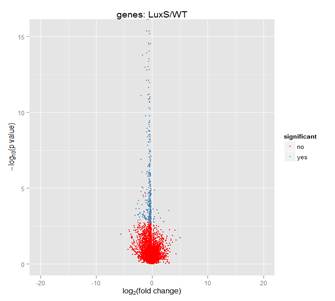 Human epithelial cells, HCT-8,
are exposed to BL21, a wild-type bacteria that produce AI-2, and a BL21 LuxS
knockout that does not produce AI-2. The
RNA is extracted and is sequenced in triplicate on two lanes of the Illumina
HiSeq1000 Sequencing System. Over 100 million reads for each condition
per biological replicate were analyzed using the Tuxedo Suite (Bowtie, Tophat
& Cufflinks). With 90% alignment, a
total of 318 differentially expressed genes and 8773 differentially expressed
isoforms were found. Gene clustering
analysis using DAVID ( Database for Annotation, Visualization and Integrated Discovery)
led to significant 28 gene clusters.
With the advancements of next generation RNA-Seq technology, sequencing of the eukaryotic transcriptome is now possible with newfound depth and breadth, to determine eukaryotic responses. In this study, transcriptional and post-transcriptional differential processing was explored and biological network paths were inferred to indicate response. Reinforced with this understanding, two-way interkingdom communication can potentially be mediated with genetically engineered bacteria that can act on eukaryotic response mechanisms.
See more of this Group/Topical: Food, Pharmaceutical & Bioengineering Division - See also TI: Comprehensive Quality by Design in Pharmaceutical Development and Manufacture