
 Google
 Yelp
 Facebook
 Twitter
 ChEnected
284255 Effect of Body Geometry On Motility of Bacteria-Powered Microrrobots (BACTERIABOTS)
EFFECT OF BODY GEOMETRY ON MOTILITY OF BACTERIA-POWERED MICRORROBOTS (BACTERIABOTS) |
Ali Sahari1, Bahareh Behkam1,2 1School of Biomedical Engineering and Sciences, Virginia Tech, Blacksburg VA 24061 2Mechanical Engineering Department, Virginia Tech, Blacksburg VA 24061
|
Abstract— Motility of micro-scale swimming robots falls in the realm of low Reynolds number, where viscous forces exerted on the robots are dominant over inertia. In this work, the importance of body geometry on the dynamics of bacteria propelled swimming microrobots (BacteriaBots) is investigated. We have experimentally demonstrated that oblong geometries enhance directionality of the micro-particles compared with spherical geometry.
<>I. INTRODUCTION
Mobile micro-robots have unique advantages such as the ability to access small spaces and the potential to be employed in large numbers as inexpensive agents of distributed systems for swarm robotic applications. Such micro-robots are envisioned to impact a diverse range of applications, including minimally invasive diagnosis and localized treatment of diseases, environmental monitoring, and homeland security [1]. Amongst the most significant obstacles to realization of mobile robots at micro-scale are the miniaturization of on-board actuators, power sources, and communication and control modules. Bio-hybrid approaches can be employed to address these challenges by integrating prokaryotic and eukaryotic cells within the robotic system [2-4]. BacteriaBot, a bio-hybrid micro-robot is constructed here by interfacing a microfabricated robot body with an ensemble of live engineered bacteria with the purpose of using the bacteria for actuation, sensing, communication and control. Motile behavior of bacteria is well characterized and falls under two characteristic modes of run and tumble. This random run and tumble behavior leads to the characteristic three dimensional random walk of bacteria and consequently to the stochastic motion of micro-objects propelled by bacteria.
Motility of spherical microstructures actuated by an ensemble of attached bacteria has been thoroughly characterized in previous literature [5-8] but a systematic study of the effect of microstructure geometry on propulsive behavior is currently missing. Mobile microrobots with optimal body geometries are envisioned to impact minimally invasive diagnosis, localized treatment of diseases and environmental monitoring. Limited particle diffusion and directional coefficient of drag are some of the attributes that are enhanced through such bio-hybrid systems. In this work, we have utilized a low-cost and high throughput technique to obtain non-spherical mico-particles and investigate the effect of particle shape on the motile behavior of the BacteriaBots.
<>II.
Materials and methods
<>A. BacteriaBot Body Fabrication
<>B. Bacteria culture
<>Escherichia coli (E. coli) strain
MG1655 was cultured in Luria Broth (1% tryptone, 0.5% yeast extract, and 0.5%
sodium chloride). The culture was grown to an optical density OD600=0.5
at 37 ˚C.
<>C. BacteriaBot Construction
The mixture of
Poly-L-lysine and micro-particles is incubated on a vortex mixer for
one hour. Bacteria are centrifuged at 3000g for 5 min and then resuspended in
motility medium (0.01M potassium phosphate, 0.067M sodium chloride, 10-4M
EDTA, 0.21M glucose, and 0.002% Tween-20). The poly-L-lysine coated
micro-particles are added to the bacteria allowing the bacteria to self-assemble
on the particles.
<>III.
Results and Discussions
It
should be noted that more than the number of bacteria attached to the
microbead, the location of attachment is expected to affect the overall
behavior. If the areal attachment density becomes significantly nonuniform, we
expect to see a change in the average net resultant force and consequently
observe a change in overall speed and directionality [3].
<>IV.
Conclusion
Variation in
motile behavior of BacteriaBots due to their body geometry can be very complex
and can only be determined experimentally. These complexities are due to: (1)
non-spherical geometries have varying coefficients of drag depending on their
aspect ratio and the direction of motion, and (2) the varying radius of curvature
on the surface of non-spherical geometries leads to preferential bacterial
adhesion in certain locations. By utilizing a high throughput PS micro-particle
manufacturing method, we characterized the motile behavior of BacteriaBots with
spherical, barrel and football shaped bodies. It was shown that for
BacteriaBots with uniform areal attachment density, body shape strongly affects
the directionality of the motion.
We are currently examining the
behavior of other geometrical shapes such as bullets. We are also investigating
if the particles size will have an impact on the observed trend.
Acknowledgment
The
authors would like to thank Professor Birgit Scharf in Biological Sciences
Department at Virginia Tech for gifting the bacteria. This work was in part
supported by the National Science Foundation (IIS-117519).
References
[1] B. Behkam, M. Sitti, "Bacteria Integrated
Swimming Micro-robots", in M. Lungarella, et al., (eds.), 50 years of AI,
Festschrift, Lecture Notes in Artificial Intellignece 4850, pp. 154-163, 2007.
 D. Two-dimensional Single Particle Tracking
 Two
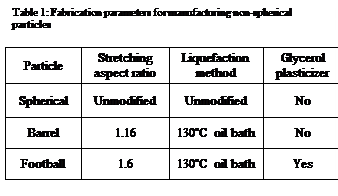
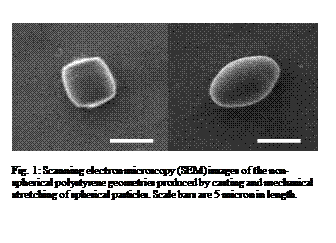
different particle geometries were fabricated using a casting and mechanical
stretching method that was described earlier. Parameters used for the manufacturing
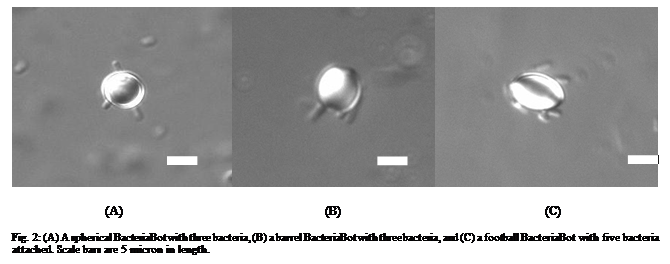
and the scanning electron microscopy (SEM) images of the resulting geometries
are given in Table 1 and Fig. 1, respectively. Representative images of the
bacteriabots with different geometries are depicted in Fig. 2. The 2D image tracking
routine was utilized to characterize the motion of the BacteriaBots. Of
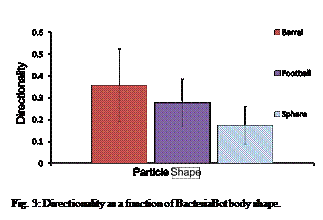
particular interest is how the body geometry will affect the directionality of
the motion of BacteriaBot without the need for active steering. Directionality
is defined as the ratio of the magnitude of the displacement vector to the
total distance traveled. To prove that the bacteria attached to the mobile microbeads are
the source of propulsion, a control experiment was performed. Minimal displacement
of the control bead confirms that the bacteria attached to the mobile
microbeads are the main source of propulsion. Therefore, any directed movement
observed for this control bead would be neither due to diffusion nor due to the
flow field generated by the free- swimming bacteria present in the background.
The experimental results for directionality of the bacteria-
 propelled bodies with
spherical, barrel, and football-shaped geometries are shown in Fig. 3. It
can be seen that the barrel and football shaped bodies are propelled with a
higher degree of directionality compared to the spherical robots. Two
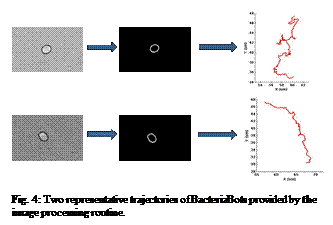
representative trajectories of the BacteriaBots are shown in Fig. 4. Number of attached bacteria for all geometries varies
between 1-6; however, our experimental results do not seem to be significantly
dependent upon the number of bacteria attached. This is consistent with our
previous observations if the attached bacteria are uniformly distributed over
the body, the overall force is expected to remain largely unchanged regardless
of the number of attached bacteria [7].
See more of this Group/Topical: Nanoscale Science and Engineering Forum