
 Google
 Yelp
 Facebook
 Twitter
 ChEnected
286146 Effect of Perfluorocarbon Vapor Concentration On Surface Tension of Water
Effect of perfluorocarbon vapor concentration on surface tension of water
Vasiliy Chernyshev and Mikhail Skliar
Chemical Engineering
University of Utah
Perfluoropentane (PFP) and other perfluorocarbons (PFCs) are highly hydrophobic, biocompatible compounds that have found a variety of medical applications. For example, stabilized perfluorocarbon are used as contrast agents during ultrasound imaging and in targeting drug delivery. Other applications include their use and aerosol propellants, lung ventilation, and anesthesia. Despite significant interest in these compounds, the study of their interfacial properties has received limited attention. Following our previous work, we investigated the influence of PFP vapor on the surface tension of a water droplet at room temperature. The droplet surface tension, volume and surface area measurements were carried out by means of real-time pendent-drop tensiometer developed us. The study followed an experimental procedure summarized in Fig. 1 and indicated substantial decrease of surface tension of water with time (Fig. 2) as a result of PFP vaporization. It was found that the tension decreases linearly with the increase of the PFP concentration in the gas phase, as shown in Figure 3. The effect of perfluorohexane vapor on surface water tension was also investigated and directionally similar but smaller influence was found.
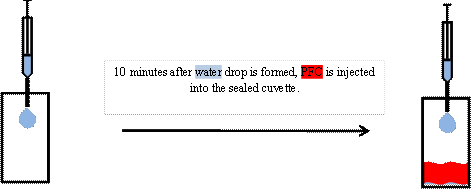
Figure 1: The experimental procedure.
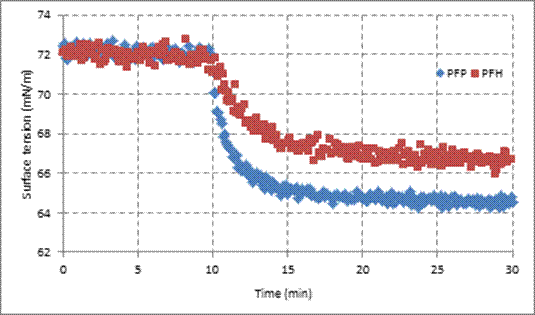
Figure 2: Surface tension of water changes with PFP and PFH evaporation. At time zero, a drop of liquid water was formed inside cuvette. After allowing 10 min for thermal and vapor-liquid water equilibration, liquid perfluorocarbon was injected. Each data point is the average of 8 runs.
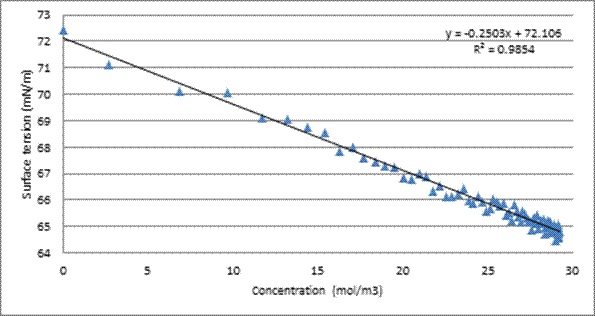
Figure 3: Correlation between water surface tension and PFP vapor concentration.
See more of this Group/Topical: Engineering Sciences and Fundamentals